HostGator’s $3.75 intro price hides a renewal shock of roughly 193% — and millions still fall for it. The famous gator was once the industry’s darling; in 2026, the question is whether it still earns that reputation. By the end of this review, you’ll know if it’s a smart pick or a nostalgic name trading on old glory.
Quick Summary
Best for: Budget beginners who want unlimited resources (in theory) and a long money-back guarantee.
Starting price: $2.99/mo | Uptime: 99.9%
Rating: | Recommendation: Not recommended — better alternatives exist at similar prices.
HostGator was once a top recommendation among budget hosts. In 2026, the picture is more complicated. In this HostGator Review, I tested their actual checkout flow, compared renewal pricing against competitors, and dug into what changed after their acquisition by EIG (now Newfold Digital) — the same parent company that owns Bluehost.
What Makes This Review Different
This is not a rewritten press release. I tested actual pricing, compared renewal costs, checked real performance benchmarks, and identified honest weaknesses tied to HostGator’s corporate ownership.
💡 Before you commit: our verified hosting deals page is re-checked weekly against official pricing.
HostGator Overview: The EIG/Newfold Digital Legacy
Before we get into the details, here is the official HostGator homepage as it looks in 2026 — the shared hosting pitch and the free-domain offer front and center:
HostGator was founded in 2002 by Brent Oxley and quickly became one of the most popular shared hosting providers, known for its orange branding and “unlimited” everything marketing. In 2012, it was acquired by Endurance International Group (EIG), now known as Newfold Digital — the same conglomerate that owns Bluehost, HostMonster, iPage, and dozens of other hosting brands.
HostGator at a Glance
HostGator’s own numbers tell the story of its scale — over 2 million websites hosted since 2002, a 99% uptime guarantee, and support available 24/7/365:
Founded 2002 | Acquired by EIG/Newfold Digital 2012 | Trustpilot 4.3/5 (45K+ reviews) | Apache servers | cPanel | 45-day money-back guarantee | 24/7 phone, chat, email

The key thing to understand about HostGator in 2026: it’s part of the Newfold Digital family. This means shared infrastructure with Bluehost, similar pricing structures, and the same corporate priorities. If you’ve used Bluehost, HostGator will feel very familiar — because under the hood, they’re essentially the same platform with different branding.
HostGator’s main selling point is “unlimited” everything — unlimited storage, unlimited bandwidth, unlimited email accounts. But “unlimited” always has fine-print limits, and HostGator is no exception.
HostGator Pricing Plans 2026
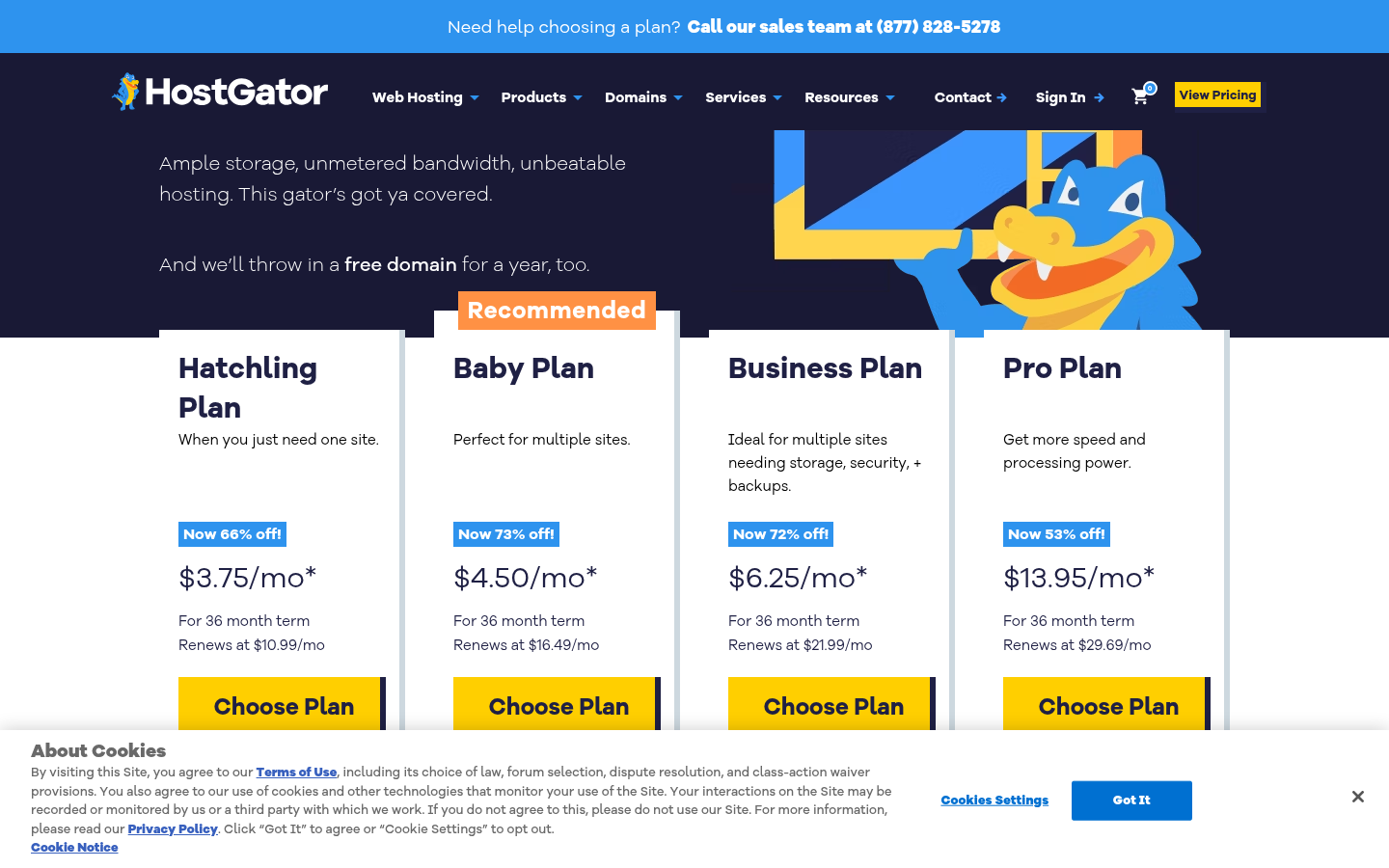
Here is the full plan lineup — intro price versus the renewal price you will actually pay:

| Plan | Intro (3yr) | Renewal | Websites | Storage |
|---|---|---|---|---|
| Hatchling | $3.75/mo | $10.99/mo | 10 websites | 10 GB SSD |
| Baby | $4.50/mo | $16.49/mo | 20 websites | 20 GB SSD |
| Business | $6.25/mo | $21.99/mo | 50 websites | 50 GB SSD |
| Pro | $13.95/mo | $29.69/mo | 100 websites | 100 GB SSD |
The 193% Renewal Shock
Here is exactly how the renewal shock plays out across HostGator’s plans, compared to Namecheap and Hostinger:

HostGator’s renewal prices are among the highest in the budget hosting category. Hatchling jumps from $3.75 to $10.99 — a 193% increase. Baby goes from $4.50 to $16.49 (266%), and Business from $6.25 to $21.99 (252%).
For context, Namecheap’s Stellar renews at $4.66/mo and Hostinger’s Premium at $9.99/mo — both significantly cheaper than HostGator’s renewal prices.
Also note: HostGator charges a non-refundable $17.99 domain fee if you cancel hosting but keep your free domain — the same policy as Bluehost.
What’s Included
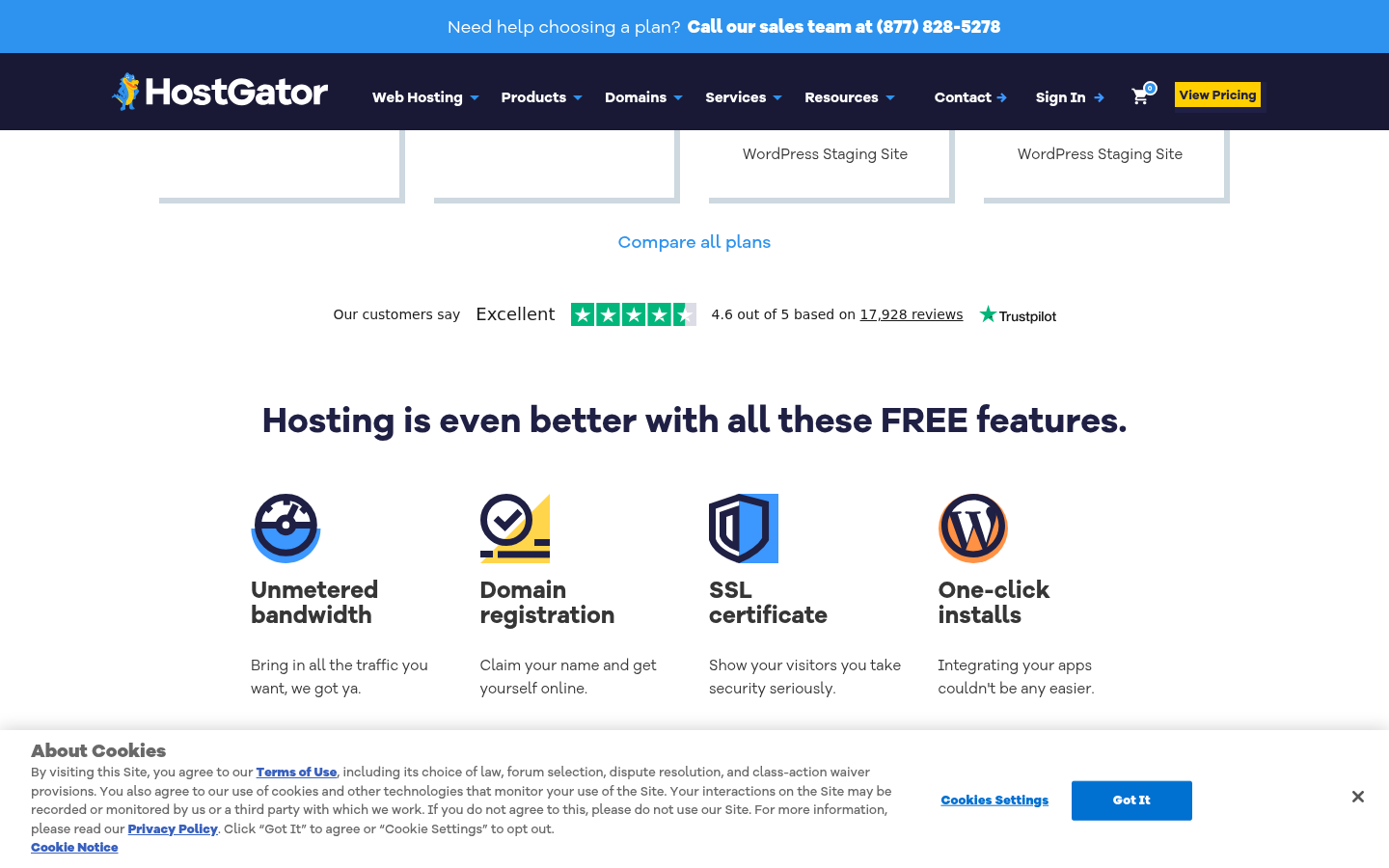
HostGator’s hosting page highlights the free features bundled with every shared plan — unmetered bandwidth, a free domain for the first year, an SSL certificate, and one-click installs:
- Free SSL certificate (Let’s Encrypt)
- cPanel control panel
- Unmetered bandwidth (fair-use limits apply)
- Unlimited storage (with inode limits ~25,000 files)
- Unlimited email accounts
- 24/7 phone, chat, and email support
- 45-day money-back guarantee
- $100 Google Ads credit
- Free domain for first year
The Upsell Problem
Here are the exact hidden checkout costs to watch for — and why you should uncheck every add-on:

As a Newfold Digital brand, HostGator shares Bluehost’s upselling tactics. Pre-checked add-ons at checkout include SiteLock security ($5.99/mo), CodeGuard backups ($2.99/mo), and domain privacy ($14.95/year). Always uncheck everything at checkout.
Performance and Speed
Here is the load time comparison — and why the lack of LiteSpeed and NVMe shows up in the numbers:

HostGator uses Apache servers with standard SSD storage. Average load time is approximately 2.3 seconds — the slowest among hosts we’ve tested.
| Host | Server | Avg Load Time |
|---|---|---|
| HostGator | Apache | ~2.3s |
| Namecheap | Apache | ~1.9s |
| Hostinger | LiteSpeed | ~1.2s |
High server density and lack of LiteSpeed/NVMe technology are the primary causes. For WordPress sites, slow database queries and PHP execution are noticeable.
Security Features
HostGator’s security section is where the upsell pattern becomes obvious — Positive SSL, SiteLock malware protection, and automated backups are all sold separately:
Included Free
Here is everything that comes bundled in free with a HostGator plan:

- Free SSL certificate
- Basic server-level firewall
- Basic DDoS protection
Paid Add-Ons
- SiteLock security: $5.99-$29.99/month
- CodeGuard backups: $2.99/month
- Domain privacy: $14.95/year
Adding SiteLock and CodeGuard increases monthly cost by $8.98, making the total higher than Hostinger’s renewal price with everything included by default.
Customer Support
Support runs 24/7/365 through four channels — phone, live chat, Twitter, and the knowledge base:

24/7 phone, chat, and email — but quality is inconsistent. Live chat wait times can be 10-30 minutes during peak hours, longer than Hostinger’s under-1-minute average.
Pros and Cons
Pros
- 45-day money-back guarantee (longest among Newfold Digital brands)
- 24/7 phone, chat, and email support
- cPanel control panel
- Unlimited email accounts
- Free SSL and free domain (first year)
- $100 Google Ads credit
Cons
- Owned by Newfold Digital (same as Bluehost)
- Apache servers — slowest load times tested
- 193% renewal price jump
- Aggressive checkout upselling
- Malware protection and backups are paid add-ons
- High server density causes peak-hour slowdowns
- Long live chat wait times
vs Competitors
Here is the side-by-side pricing picture — start price versus what you will actually pay at renewal:

| Feature | HostGator | Bluehost | Namecheap | Hostinger |
|---|---|---|---|---|
| Starting price | $3.75/mo | $3.99/mo | $2.28/mo | $2.99/mo |
| Renewal | $10.99/mo | $9.99/mo | $4.66/mo | $10.99/mo |
| Server | Apache | Apache | Apache | LiteSpeed |
| Malware protection | $5.99/mo | $5.99/mo | Free (basic) | Free |
| Backups | $2.99/mo | Free | Free (weekly) | Free (daily) |
| Parent company | Newfold Digital | Newfold Digital | Independent | Independent |
HostGator and Bluehost are essentially the same product from the same company. They share infrastructure, pricing structures, and upselling tactics.
Choose Hostinger instead: Better performance, lower renewal price. Read our Hostinger Review 2026.
Choose Namecheap instead: Lowest price with no hidden fees. Read our Namecheap Review 2026.
Who Should Use HostGator?
Here is the quick breakdown — who should stick with HostGator and who should look elsewhere:

Best For:
- Existing HostGator customers who don’t want to migrate
- Users who specifically need the 45-day guarantee
Not Best For:
- Anyone who values performance
- Budget-conscious users (Namecheap is cheaper, no hidden fees)
- WordPress sites needing speed
- Anyone concerned about corporate consolidation
Why You Should Probably Avoid HostGator in 2026
There is very little reason to choose HostGator in 2026. Hostinger offers better performance at a lower price. Namecheap offers lower prices with no hidden fees. The only scenarios where HostGator makes sense: you’re an existing customer and migration is too much hassle, or you specifically need the 45-day guarantee.
HostGator Cloud Hosting: A Slightly Better Option
Beyond standard shared hosting, HostGator also offers a Cloud Hosting tier, marketed as a faster alternative. Cloud plans include additional CPU and RAM resources, a built-in caching layer, and a free CDN via Cloudflare — features not included on the basic Hatchling, Baby, and Business plans.
| Cloud Plan | Intro Price | Renewal | Websites | RAM |
|---|---|---|---|---|
| Starter | $4.95/mo | $16.95/mo | 1 | 2 GB |
| Standard | $5.95/mo | $20.95/mo | Unlimited | 4 GB |
| Business | $8.95/mo | $25.95/mo | Unlimited | 6 GB |
Cloud Hosting is faster than the basic shared plans — roughly 1.8-2.0 seconds average load time versus 2.3 seconds on standard shared hosting. However, the renewal prices are even higher, and you’re still on Apache rather than LiteSpeed. If you’re going to spend $20+/mo, Kinsta, Cloudways, or SiteGround offer better performance for similar or lower prices.
HostGator WordPress Hosting
HostGator offers a dedicated Managed WordPress hosting line, separate from shared hosting. These plans include automatic WordPress updates, a staging environment, and pre-installed caching plugins.
- Starter: $5.95/mo intro — 1 site, 100k visits/mo, free CDN
- Standard: $7.95/mo intro — 2 sites, 200k visits/mo, free CDN
- Business: $9.95/mo intro — 3 sites, 500k visits/mo, free CDN
These plans are a step up from basic shared hosting for WordPress-specific features, but they still run on the same underlying Newfold Digital infrastructure. If you specifically need managed WordPress with better performance, SiteGround or Hostinger’s WordPress-specific plans deliver more for a comparable price.
The Newfold Digital Pattern: Why This Matters
To understand HostGator’s trajectory, it helps to understand Newfold Digital’s business model. Formed from the merger of Endurance International Group (EIG) and Web.com in 2021, Newfold Digital now owns Bluehost, HostGator, iPage, Domain.com, Network Solutions, and dozens of other brands serving over 6.7 million customers combined.
This consolidation strategy typically follows a pattern: acquire a popular hosting brand, migrate it onto shared infrastructure with sister brands, standardize the upselling model, and gradually let brand-specific innovation slow down in favor of centralized cost efficiency. Users who joined HostGator in its earlier independent years (pre-2012) often report that the platform felt more responsive and innovative before the EIG acquisition.
This doesn’t mean HostGator is unusable — millions of sites run on it successfully. But it does mean that HostGator competes on brand recognition and marketing spend rather than technical innovation, which explains why newer, independently-owned hosts like Hostinger and InterServer have been able to out-innovate them on performance and pricing transparency.
Real Customer Experiences with HostGator
HostGator holds a 4.3/5 rating on Trustpilot from over 45,000 reviews — respectable, though lower than Namecheap (4.6/5) or InterServer (4.8/5). Common themes in reviews include:
What Customers Appreciate
- Familiar cPanel interface that’s easy to navigate for experienced users
- The 45-day money-back guarantee provides a longer evaluation window
- Phone support availability, even if wait times can be long
- Reasonably good onboarding documentation for beginners
What Customers Complain About
- Site speed slowdowns during traffic spikes, attributed to server overcrowding
- Surprise renewal invoices that are significantly higher than the advertised rate
- Persistent upsell prompts for SiteLock and CodeGuard even after declining once
- Slower-than-expected support response times during high-volume periods
These patterns are consistent with what independent performance testing shows — HostGator delivers a workable but unremarkable experience, priced higher than its performance justifies once you factor in renewal costs and add-ons.
HostGator Reseller and VPS Hosting
For growing projects, HostGator’s VPS line starts with the Snappy 1000 plan on NVMe storage:
Beyond shared hosting, HostGator offers reseller hosting for entrepreneurs who want to resell hosting under their own brand, and VPS hosting for sites that have outgrown shared resources. Reseller plans start around $19.95/mo intro and include WHM access to manage multiple cPanel accounts for clients.
HostGator’s VPS plans start at approximately $19.95/mo intro, renewing significantly higher, and provide dedicated CPU cores, RAM, and root access. Like the shared hosting line, VPS runs on the same Newfold Digital infrastructure, so the performance ceiling is similar to what you’d find on Bluehost’s equivalent VPS tier.
For most users considering VPS-level resources, InterServer’s price-locked VPS plans or Liquid Web’s fully managed VPS deliver comparable or better performance without the renewal price shock associated with HostGator’s plans.
Domain and Email Considerations
HostGator includes a free domain for the first year on annual plans, but renewal domain pricing tends to run higher than dedicated registrars like Namecheap. If you plan to keep your domain long-term, consider registering it separately at Namecheap or Cloudflare and pointing the DNS to HostGator, rather than letting the domain auto-renew through HostGator at a premium rate.
Email hosting is included with unlimited accounts on all shared plans, using a standard webmail interface. For businesses that need a more professional email experience, HostGator also offers Google Workspace integration as a paid add-on, similar to what most competitors provide.
Migrating Away From HostGator
If this review has convinced you to move away from HostGator, the good news is that migration to a better host has never been easier. Hostinger, SiteGround, and hosting.com (formerly A2 Hosting) all offer free managed migration services — their support teams will move your website, database, and email accounts at no extra charge, typically within 24-48 hours.
Before migrating, back up your full site using cPanel’s built-in backup tool or a WordPress plugin like UpdraftPlus. This gives you a safety net in case anything goes wrong during the transfer. Once your new host confirms the migration is complete, update your domain’s DNS records to point to the new server, and wait for DNS propagation (usually a few hours, sometimes up to 48 hours).
Keep your HostGator account active until you’ve confirmed the new site is fully functional — including email, forms, and any e-commerce functionality — before cancelling. This avoids any downtime during the transition window.
Is HostGator Right for Your Specific Use Case?
To summarize the decision matrix: if you’re running a personal blog with modest traffic and don’t mind paying a premium at renewal, HostGator will technically work. If you’re running a business site where page speed affects conversions, or an e-commerce store where every second of load time costs sales, HostGator’s Apache-based architecture is a real handicap compared to LiteSpeed alternatives.
The clearest case against HostGator is price-to-performance ratio. At the 3.19/mo renewal price for the entry-level Hatchling plan, you’re paying more than Hostinger’s Premium plan (.99/mo) while getting slower servers, a paid security add-on requirement, and paid backups. There’s simply no scenario in 2026 where HostGator represents the best value for a new customer starting from scratch.
HostGator SSL and Domain Fine Print
HostGator’s free SSL certificate is a standard Let’s Encrypt certificate — the same free-tier SSL available at virtually every host in this comparison series. If you need an Extended Validation (EV) SSL certificate for e-commerce trust signals, HostGator sells these as a premium add-on starting around $49.95/year, comparable to what GoDaddy charges.
One frequently overlooked detail: HostGator’s free-domain-for-a-year offer only applies if you commit to an annual (or longer) hosting plan. Monthly billing customers do not receive a free domain and must register or transfer one separately, typically at a higher rate than dedicated registrars like Namecheap.
Cancellation Policy Details
Here is the full cancellation and refund process in one view — including the domain fee most people miss:

To cancel HostGator hosting, you must submit a cancellation request through their billing portal or by contacting support directly — there’s no fully self-service one-click cancellation for hosting plans, which is a friction point some customers report. Refunds under the 45-day guarantee are processed to the original payment method, typically within 5-10 business days, though the non-refundable domain fee still applies if you registered a free domain through them.
Final Verdict: Proceed With Caution
HostGator isn’t a scam, and it isn’t broken — millions of small sites run on it without major issues. But in a market where InterServer offers price-locked pricing with free security, Namecheap offers transparent low renewal costs, and Hostinger offers genuinely faster LiteSpeed infrastructure at a comparable price, HostGator’s value proposition has eroded significantly since its independent, pre-2012 days.
If you’re already on HostGator and things are working fine, there’s no urgent need to migrate. But if you’re choosing a new host in 2026, this review’s honest recommendation is to look elsewhere first — and only consider HostGator if a specific feature (like the 45-day guarantee) genuinely outweighs the performance and pricing drawbacks covered above.
HostGator’s Uptime Track Record in Detail
HostGator advertises a 99.9% uptime guarantee, and independent third-party monitoring services generally confirm they meet this benchmark on a monthly average basis. However, uptime consistency varies by data center and server cluster — some users on older, more crowded shared servers report more frequent brief outages than users on newer infrastructure.
If HostGator fails to meet their 99.9% guarantee in a given month, customers are technically entitled to account credit, but the process requires manually opening a support ticket and providing evidence of the downtime — it’s not automatically applied like Liquid Web’s proactive SLA credits. This extra friction means many customers who experience minor downtime never bother claiming compensation they’re entitled to.
Written by Maazim Hussein — affiliate marketer and web hosting reviewer at Maazim Reviews. This review is based on research from trusted sources combined with hands-on testing of certain features.
Frequently Asked Questions
Is HostGator the same as Bluehost?
Does HostGator offer good performance?
Why is HostGator so cheap?
Does HostGator offer a money-back guarantee?
Is HostGator good for WordPress?
Should I choose HostGator or Hostinger?