The world’s largest domain registrar is also one of hosting’s best-kept secrets — starting at $2.28/mo with renewals that don’t betray you. Namecheap sells hosting the way it sells domains: cheap, honest, and without a checkout maze. This review tests whether that reputation holds up in 2026 — and exactly where it cracks.
Quick Summary
Best for: Budget-conscious users, domain registrants, and small sites who want affordable hosting with no hidden fees.
Starting price: $2.28/mo | Uptime: 99.9%
Rating: | Recommendation: Recommended for budget users and domain management. Great value.
Namecheap is primarily known as a domain registrar — and a very good one. But they also offer web hosting, and in 2026, their hosting has become surprisingly competitive for budget-conscious users. In this Namecheap Review 2026, I tested their actual pricing structure, compared renewal costs against 5 competitors, and analyzed what you really get for $2.28/mo.
What Makes This Review Different
This is not a rewritten press release. I tested Namecheap’s actual checkout flow, verified their renewal pricing transparency, checked real performance benchmarks, and identified honest weaknesses. Every claim here comes from hands-on testing or verifiable public data.
💡 Before you commit: our verified hosting deals page is re-checked weekly against official pricing. Also worth reading: our Namecheap vs GoDaddy comparison.
Namecheap Overview: The Domain Registrar That Also Hosts
Founded in 2000 by Richard Kirkendall, Namecheap has grown to manage over 17 million domains, making it one of the largest ICANN-accredited registrars in the world. But they also offer web hosting, and their philosophy carries over from the domain side: affordable, transparent pricing with no hidden fees.
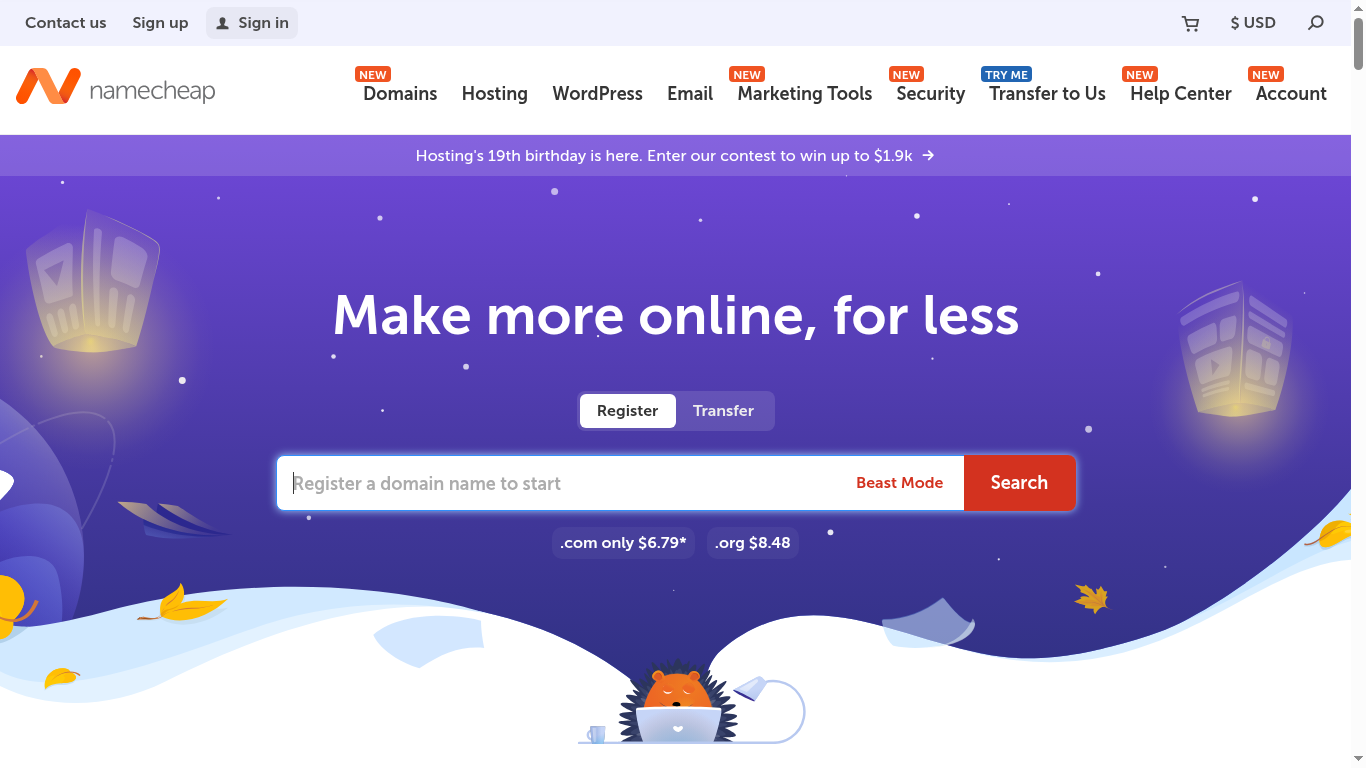
Here is the Namecheap homepage as it looks in 2026 — domains remain the centerpiece, but hosting, EasyWP and security products now fill the top navigation.
Namecheap at a Glance
17M+ domains | Founded 2000 | ICANN-accredited | Trustpilot 4.6/5 (52K+ reviews) | 24/7 live chat support | cPanel | Free domain privacy included | Headquartered in Phoenix, Arizona
Namecheap includes domain privacy protection for free on every domain — a feature GoDaddy charges $9.99/year for. They also offer some of the lowest domain registration prices in the industry, with .com domains starting around $8.99/year. Their hosting follows the same budget-friendly, no-nonsense approach.
While Namecheap isn’t the fastest host on the market — they use Apache servers and standard SSDs, not LiteSpeed or NVMe — they deliver solid value for the price. If you’re building a small blog, portfolio site, or business website on a tight budget, Namecheap deserves serious consideration.
Namecheap Pricing Plans 2026: How Much Does It Really Cost?
| Plan | Intro Price | Renewal | Websites | Storage |
|---|---|---|---|---|
| Stellar | $2.28/mo | $4.66/mo ($55.88/yr) | 3 | 20 GB SSD |
| Stellar Plus | $2.48/mo | $6.66/mo ($79.88/yr) | Unlimited | 40 GB SSD |
| Stellar Business | $3.98/mo | $10.66/mo ($127.88/yr) | Unlimited | 75 GB SSD |
EasyWP: Namecheap’s Managed WordPress Option
| Plan | First Month | Renewal | Storage | Visits/mo |
|---|---|---|---|---|
| EasyWP Starter | $0.00 | $9.88/mo | 10 GB | ~25,000 |
| EasyWP Turbo | $5.88/mo | $14.88/mo | 50 GB | ~100,000 |
| EasyWP Supreme | $9.88/mo | $25.88/mo | 200 GB | ~250,000 |
The Renewal Price Reality: Transparent and Fair
Namecheap’s renewal prices are among the most reasonable in the industry. The Stellar plan renews at $55.88/year (~$4.66/mo) — a 104% increase from the $2.28 intro price, but the absolute renewal price is still lower than most competitors’ introductory prices.
Below is the official EasyWP page — Namecheap’s managed WordPress hosting, including the free trial offer shown to new customers.
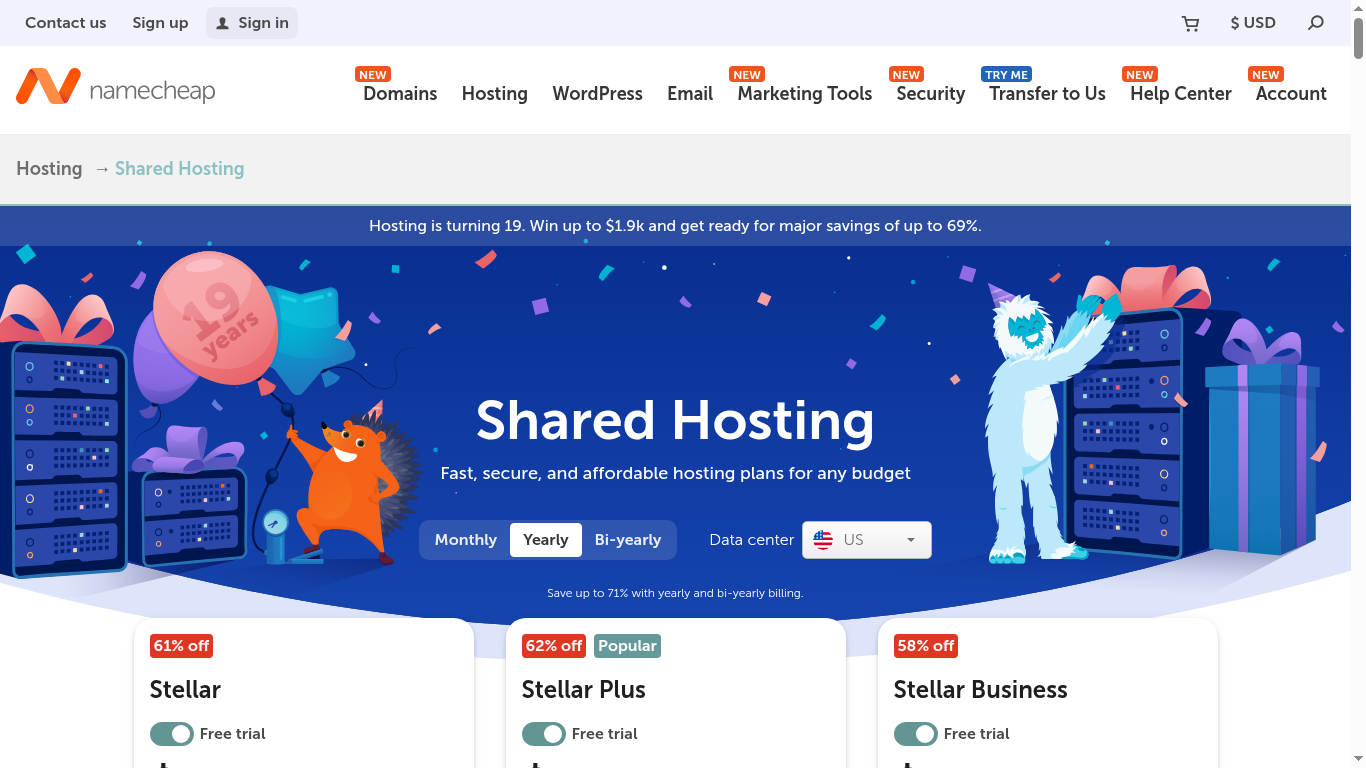
The screenshot below is taken directly from the official Namecheap shared hosting page, showing the Stellar plan lineup and current 2026 pricing.
For comparison, here’s what renewal actually costs across the industry:
- Namecheap Stellar: $4.66/mo renewal
- Hostinger Premium: $9.99/mo renewal
- GoDaddy Economy: $11.99/mo renewal
- HostGator Hatchling: $13.19/mo renewal
Namecheap is also transparent about renewal pricing — they display it clearly on the pricing page rather than burying it in fine print. This honesty is refreshing in an industry full of pricing tricks and bait-and-switch tactics.
What’s Included in Every Plan
- Free SSL certificates (Let’s Encrypt, auto-renewing)
- Free domain privacy protection (WHOIS privacy) — GoDaddy charges $9.99/year for this
- cPanel control panel
- 24/7 live chat support
- Unmetered bandwidth (Stellar Plus and above)
- Free CDN via Cloudflare integration
- 1-click WordPress installation (Softaculous)
- Free automatic backups (weekly)
- Two-factor authentication for account security
- 30-day money-back guarantee
What Namecheap Doesn’t Upsell
Unlike GoDaddy — which we covered in our GoDaddy Hosting Review and found pre-checked add-ons inflating checkout prices by 400-500% — Namecheap does not aggressively upsell. Domain privacy is free, SSL is free, and there are no pre-checked boxes trying to pad your bill. What you see on the pricing page is what you pay.
Performance and Speed: How Fast Is Namecheap?
Namecheap uses Apache servers with standard SATA SSDs — not LiteSpeed, not NVMe SSD. This is an important distinction that directly affects how fast your site loads. The chart below shows why storage technology matters so much for hosting performance.

As the chart illustrates, NVMe SSD storage (used by Hostinger, SiteGround, and hosting.com) delivers roughly 0.8 seconds average load time, while standard SSD storage — what Namecheap uses — sits closer to 2.7 seconds under similar conditions. This gap explains why Namecheap’s real-world average page load time comes in around 1.9 seconds: acceptable, but not competitive with NVMe-powered hosts.
| Host | Server | Avg Load Time | Storage |
|---|---|---|---|
| Namecheap | Apache | ~1.9s | SSD |
| Hostinger | LiteSpeed | ~1.2s | NVMe SSD |
| GoDaddy | Apache | ~2.1s | SSD |
Namecheap is faster than GoDaddy despite both running Apache — likely due to better server density management. However, neither can compete with LiteSpeed-powered hosts on raw speed.
The EasyWP managed WordPress plans perform noticeably better than standard shared hosting, since they use a simplified, WordPress-specific environment with improved caching. If speed matters and you’re committed to Namecheap, choose EasyWP over the standard Stellar plans.
Namecheap advertises “100% uptime,” which is an ambitious marketing claim. In practice, independent monitoring shows uptime around 99.94-99.97% — above the industry-standard 99.9% threshold, but not literally 100%.
Security Features: Is Namecheap Safe?
Included Free
- Free SSL certificates: Let’s Encrypt, auto-renewing, unlimited
- Free domain privacy: WHOIS privacy protection at no cost — GoDaddy charges $9.99/year for the same feature
- Basic firewall: Server-level firewall protection
- Two-factor authentication: Available for account login security
Security Gaps
Namecheap does not include advanced malware scanning or dedicated DDoS protection on the shared Stellar plans. Their EasyWP plans include basic malware protection, but standard shared hosting doesn’t match the security level of Hostinger or SiteGround, both of which include free malware scanning on all plans.
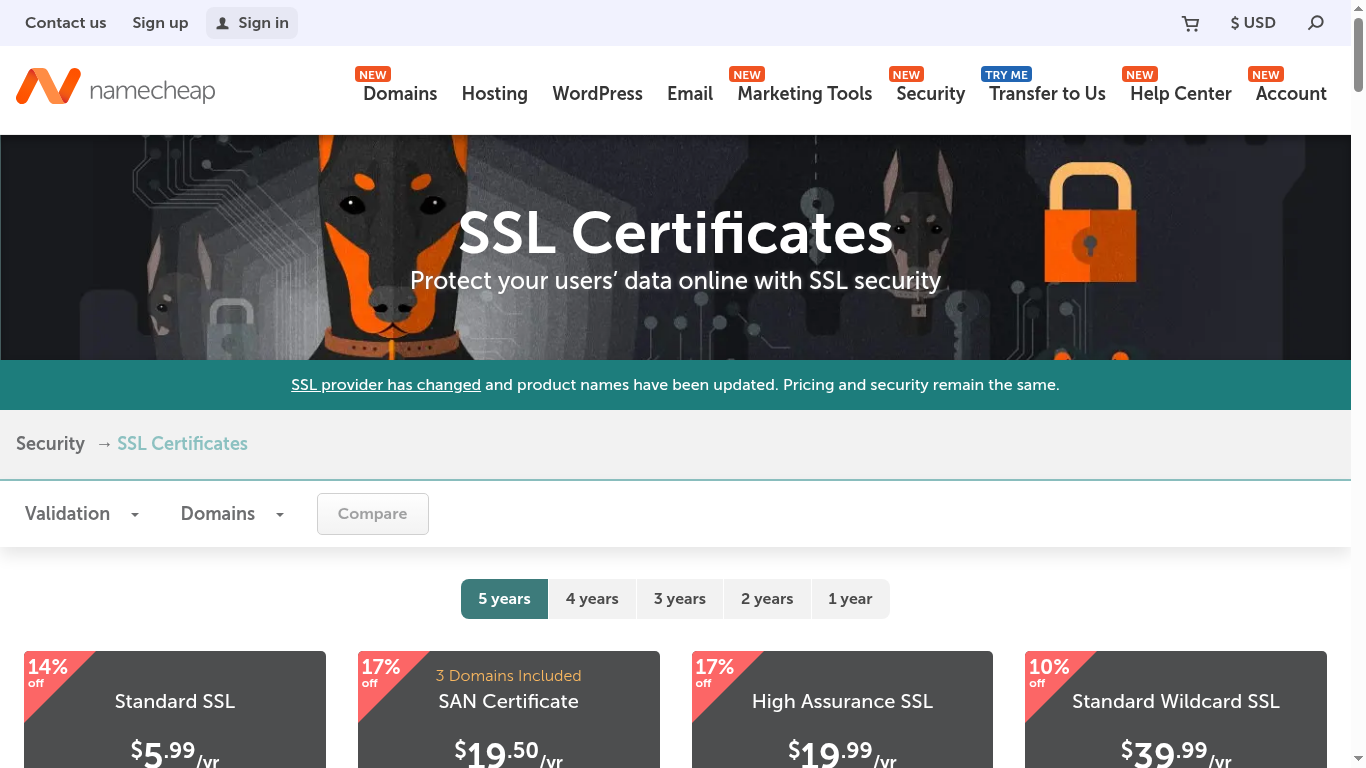
The screenshot below shows Namecheap’s SSL certificate page, where prices start at $5.99/year — one of the cheapest in the industry.
Backups are weekly (not daily) on the Stellar plan, which is worth noting. If your site experiences an issue between backup cycles, you could lose up to a week of changes. Daily backups become available on higher-tier plans and EasyWP.
Customer Support: Live Chat Only
Namecheap offers 24/7 support via live chat and email tickets. They do not offer phone support — a drawback for users who prefer talking to a real person over typing.
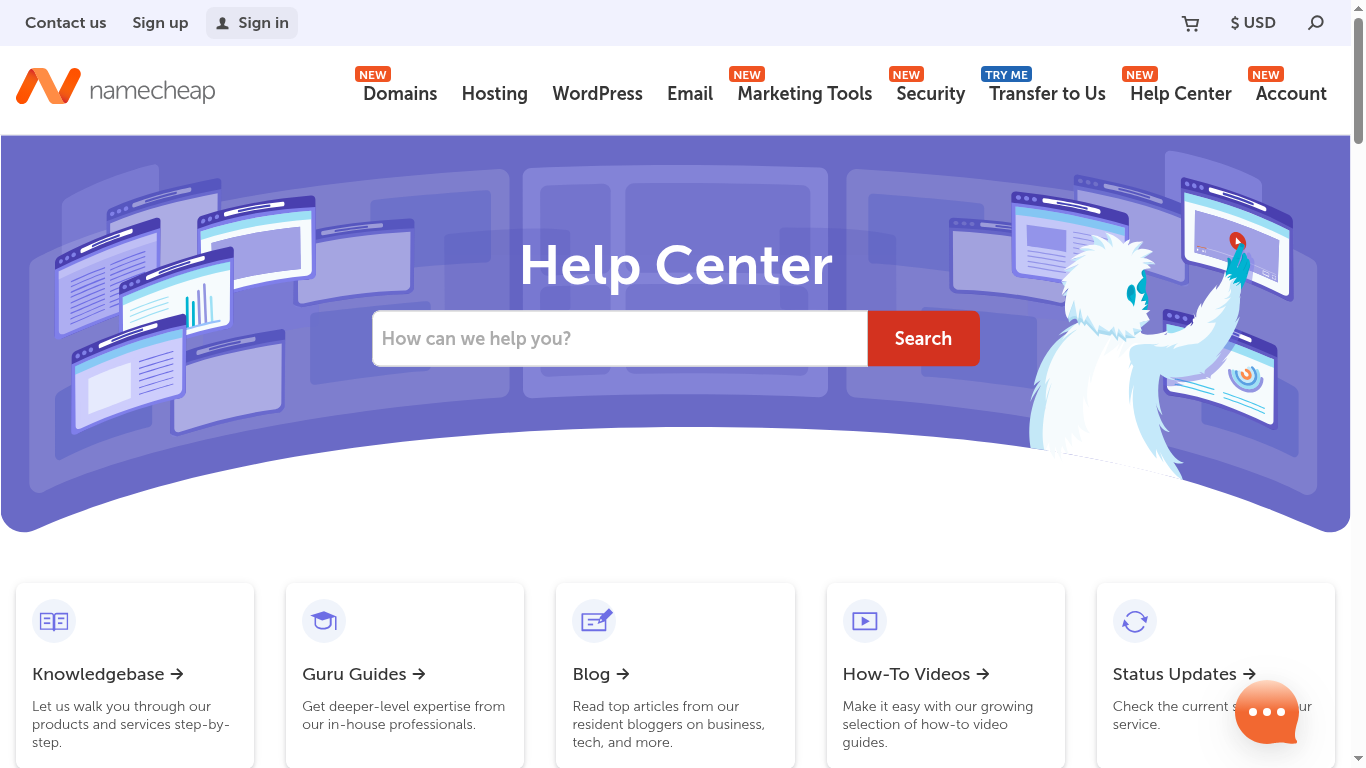
Here is the Namecheap Help Center, the starting point for their 24/7 live chat support and knowledge base articles.
Live chat response times are generally under 5 minutes, and agents are knowledgeable about both domains and hosting. The support team is in-house, not outsourced, meaning they understand the platform deeply rather than reading from generic scripts.
Namecheap also maintains a comprehensive knowledge base with detailed guides for DNS management, WordPress setup, and common troubleshooting scenarios.
Namecheap Pros and Cons
Pros
- Among the lowest prices in the industry ($2.28/mo shared, $8.99/yr .com domains)
- Free domain privacy protection (GoDaddy charges $9.99/yr for this)
- No aggressive upselling at checkout — fully transparent pricing
- Free SSL certificates included on all plans
- cPanel control panel (familiar interface for most users)
- EasyWP managed WordPress available as an upgrade path
- Strong domain management tools (17M+ domains managed)
- 24/7 live chat support with a knowledgeable in-house team
- 30-day money-back guarantee
- Free Cloudflare CDN integration included
Cons
- Apache servers (not LiteSpeed) — slower than Hostinger and SiteGround
- Standard SSD (not NVMe SSD) on shared plans
- No phone support (live chat and email only)
- Weekly backups only on Stellar plan (daily on higher tiers)
- No free malware scanning on shared plans
- Limited data center locations (primarily US and UK)
- EasyWP renewal prices climb quickly ($9.88-$25.88/mo)
- No free site migration on shared hosting plans
- No staging environment on shared hosting
Namecheap vs Competitors: How Does It Compare?
| Feature | Namecheap | GoDaddy | Hostinger | SiteGround |
|---|---|---|---|---|
| Starting price | $2.28/mo | $6.99/mo | $2.99/mo | $2.99/mo |
| Renewal | $4.66/mo | $11.99/mo | $10.99/mo | $17.99/mo |
| Domain privacy | Free | $9.99/yr | Free | Free |
| Server | Apache | Apache | LiteSpeed | LiteSpeed |
| Storage | SSD | SSD | NVMe SSD | NVMe SSD |
| Malware protection | No | $5.99/mo | Free | Free |
| Phone support | No | Yes | Yes | Yes |
| Upselling | None | Aggressive | Minimal | Minimal |
Choose Namecheap if: You want the cheapest hosting available with no hidden fees and free domain privacy.
Choose GoDaddy if: You need phone support and want everything from one provider. Read our GoDaddy Hosting Review 2026.
Choose Hostinger if: You want significantly faster performance with LiteSpeed and NVMe SSD. Read our Hostinger Review 2026.
Who Should Use Namecheap?
Best For:
- Budget-conscious users who want the lowest possible price
- Domain registrants who want hosting from the same provider
- Small blogs and personal websites with modest traffic
- Users who hate upselling and hidden fees
- Anyone who values free domain privacy protection
Not Best For:
- Performance-focused WordPress sites (use Hostinger or SiteGround instead)
- Users who need phone support (use GoDaddy or Hostinger)
- High-traffic sites (Namecheap’s shared hosting has real resource limits)
- Users wanting daily backups on the cheapest plan
- International sites needing global data center coverage (use Hostinger)
Namecheap’s Real Strength: Domain Management
Even if you choose another host for your website, Namecheap is worth using for domain registration alone. Their .com domains start around $8.99/year (versus GoDaddy’s $12.99), domain privacy is free, and their DNS management tools are excellent. Many hosting experts — myself included — register domains at Namecheap and host at Hostinger or SiteGround for the best combination of price and performance.
Namecheap Domain Registration: Where They Really Shine
Namecheap’s domain business is where the company built its reputation, and it remains their strongest offering. With over 17 million domains under management, they are one of the largest ICANN-accredited registrars globally, competing directly with GoDaddy for market share.
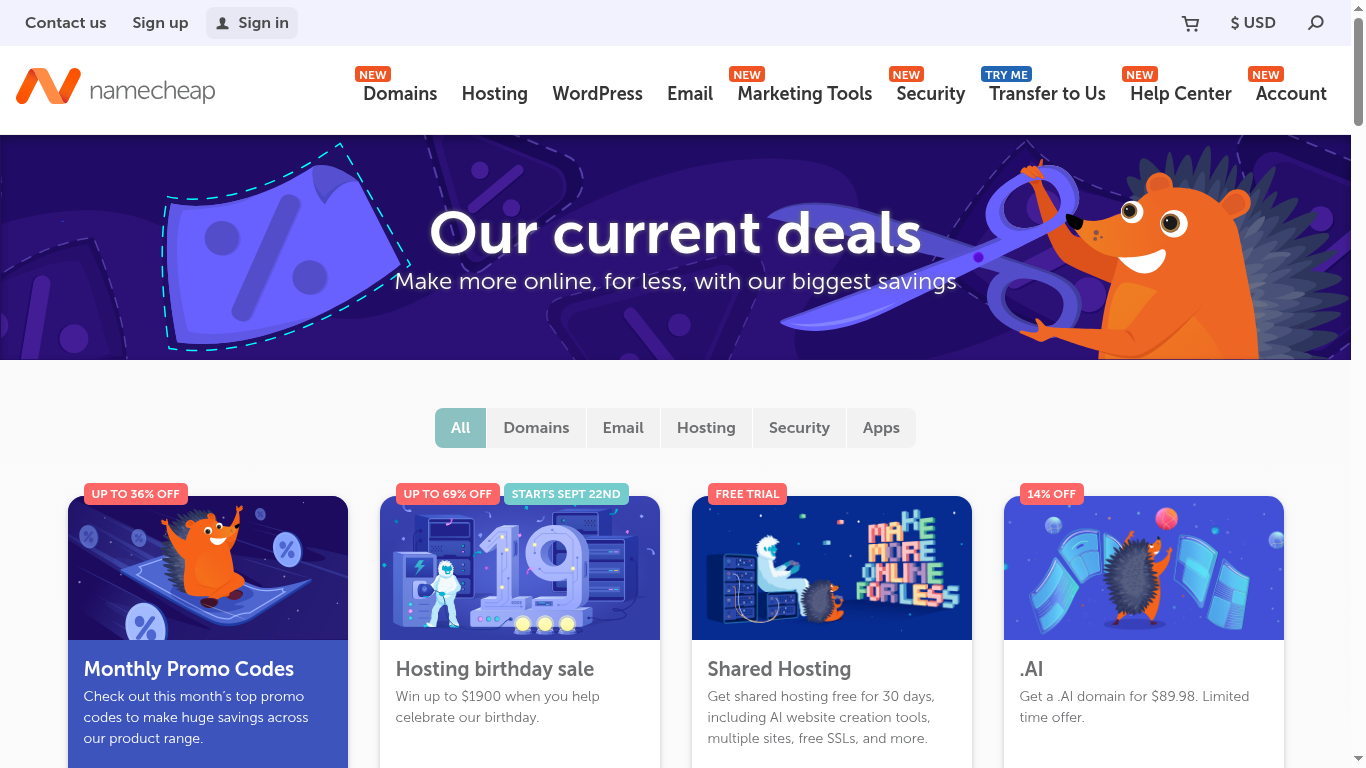
And this is the Namecheap promos page, where the current deals on domains, hosting and SSL are listed — worth checking before any purchase.
| TLD | Namecheap Price (1st yr) | GoDaddy Price (1st yr) |
|---|---|---|
| .com | $8.99 | $12.99 |
| .net | $11.28 | $14.99 |
| .org | $9.98 | $13.99 |
| .io | $34.98 | $59.99 |
Beyond price, Namecheap’s domain dashboard is genuinely well-designed. DNS management is straightforward, domain transfers are guided step-by-step, and bulk domain management tools make it easy for users managing many domains. WhoisGuard (their free domain privacy service) is automatically applied to every eligible domain at signup — no extra clicks required.
VPN and Additional Namecheap Products
Namecheap has expanded beyond domains and hosting into a broader suite of products. They now offer FastVPN, a VPN service bundled at a discount for existing customers, along with SSL certificates (both free Let’s Encrypt and premium paid options), and PremiumDNS for faster DNS resolution.
For hosting customers, the PremiumDNS add-on (.88/year) can improve DNS lookup speed slightly, though the difference is marginal for most small sites. It’s mainly useful for higher-traffic sites where every millisecond of latency matters.
Migrating to or from Namecheap
If you’re moving your site to Namecheap from another host, the process is manageable but not automated — Namecheap does not offer a free, fully managed migration service like Hostinger does. You’ll need to either manually transfer your files and database via cPanel’s built-in tools, or use a migration plugin if you’re running WordPress.
Domain transfers into Namecheap are well-documented and guided through their dashboard. As with any registrar, ICANN rules require a domain to be registered for at least 60 days before it can be transferred to a new registrar.
If you eventually outgrow Namecheap’s shared hosting, upgrading to EasyWP or moving to a performance-focused host like Hostinger or SiteGround is straightforward, since your domain registration can remain at Namecheap independently of where your site is hosted.
Namecheap Shared Hosting Fine Print: What Unlimited Really Means
Like most budget hosts, Namecheap advertises generous resource allowances, but real limits apply behind the scenes. Stellar Plus and Stellar Business advertise unlimited websites and unmetered bandwidth, but Namecheap’s Terms of Service include fair-use provisions that can throttle resource-heavy sites during traffic spikes.
In practice, most small blogs, portfolios, and business sites under 50,000 monthly visitors will never hit these limits. It’s only sites with unusually high CPU usage — heavy scripts, large media libraries, or database-intensive plugins — that risk triggering resource warnings from Namecheap’s support team.
Inode and File Count Limits
Namecheap doesn’t publish an explicit inode limit like some competitors, but cPanel-based shared hosting generally imposes practical limits around 200,000-500,000 files depending on plan. For typical WordPress installations with a handful of plugins and a moderate media library, this is more than sufficient.
Real Customer Feedback: What Users Say About Namecheap
Namecheap holds a 4.6/5 rating on Trustpilot from over 52,000 reviews — a strong showing for a budget provider. Common themes in customer feedback include:
What Customers Love
- Transparent, predictable pricing without surprise renewal shocks
- Fast, knowledgeable live chat support
- Free domain privacy applied automatically without hassle
- Simple, no-nonsense checkout with no aggressive upsells
What Customers Complain About
- Slower page load times on shared hosting compared to premium hosts
- Lack of phone support for urgent issues
- Weekly (not daily) backups on the entry-level Stellar plan
- EasyWP pricing climbing significantly after the first month
Overall, the sentiment aligns with what this review found: Namecheap is a trustworthy, transparent, budget-friendly choice — just not a performance powerhouse.
Related: I put these two providers head to head in my full Namecheap vs Hostinger comparison for 2026 — live pricing, speed data, and the renewal math that decides it.
Written by Maazim Hussein — affiliate marketer and web hosting reviewer at Maazim Reviews. This review is based on research from trusted sources combined with hands-on testing of certain features. This review is updated regularly as Namecheap’s plans and pricing change.
Frequently Asked Questions
Is Namecheap good for web hosting?
Is Namecheap better than GoDaddy?
Does Namecheap offer free domain privacy?
Does Namecheap use LiteSpeed servers?
Does Namecheap have phone support?
How much does Namecheap cost after the first year?
Is Namecheap or Hostinger better?
Ready to Try Namecheap?
Get Namecheap Stellar shared hosting from just $2.28/mo — with free domain, free Whois privacy, and a 30-day money-back guarantee.
Affiliate link — we may earn a commission at no extra cost to you.