One of these hosts spends millions on Super Bowl ads — and its customers quietly pay for them. In this Namecheap vs GoDaddy face-off, the smaller brand keeps renewals fair while the giant’s checkout is a maze of upsells. By the end, you’ll know which host actually deserves your first website.

Related comparison: torn between the two budget leaders? Our Namecheap vs Hostinger comparison breaks down pricing, performance, and renewal traps head to head.
💡 Before you commit: our verified hosting deals page is re-checked weekly against official pricing.
What we actually compared
Namecheap and GoDaddy are both major names in domains and hosting, but they serve different buyer profiles. Namecheap built its reputation on affordable domain registration and budget shared hosting with cPanel. GoDaddy is the world’s largest domain registrar and bundles hosting with website building, marketing tools, email, and payment processing into one ecosystem.
This comparison focuses on shared web hosting, the product most readers are deciding between. We looked at both providers’ official pricing pages and documentation, reviewed the leading search results for “Namecheap vs GoDaddy,” and applied what we learned from our full-length Namecheap Review 2026 and GoDaddy Hosting Review 2026. Prices can change by country, currency, tax, billing term, promotion, and account status, so treat the figures below as a transparent September 2026 snapshot, not a permanent quote.
We also checked the first five prominent organic comparison results. They generally agree that Namecheap is cheaper, but many repeat introductory prices without explaining renewal costs, server technology, or backup policies. We fill those gaps below.
Pricing: the first payment is not the whole story
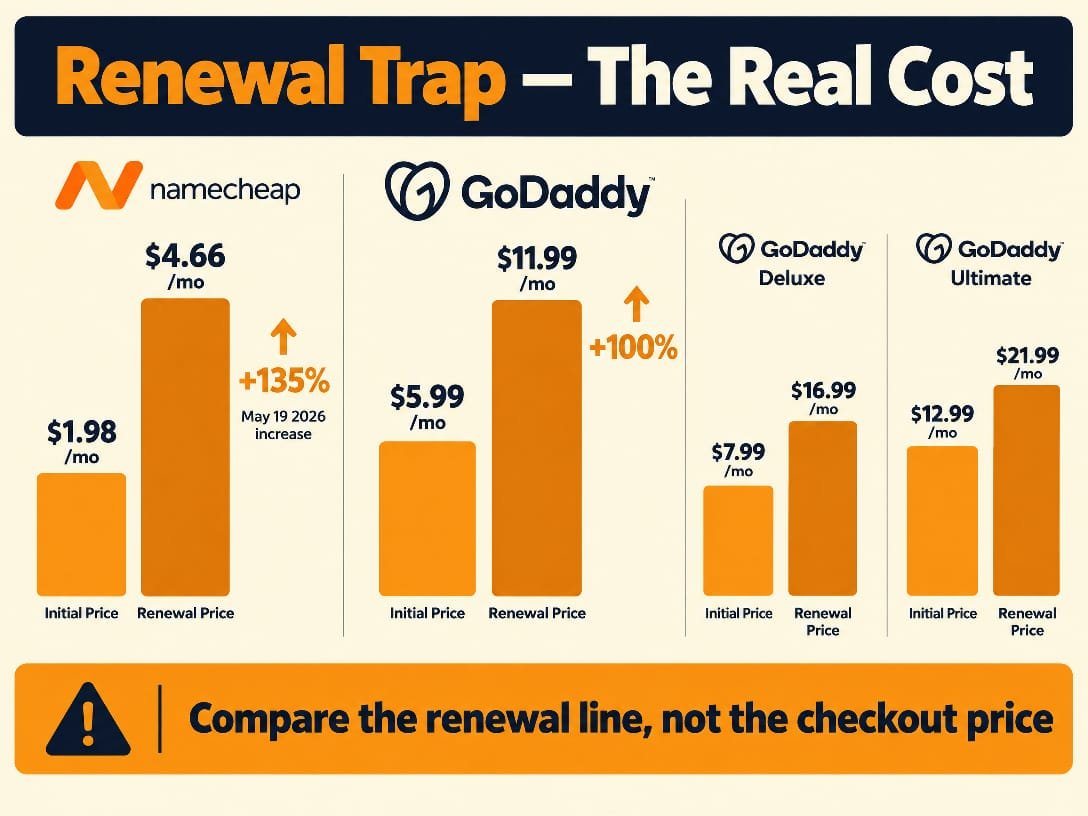
On Namecheap’s official hosting page at the time of research, the Stellar plan started at $2.28 per month on an introductory basis. The official Namecheap knowledge base confirms the following renewal prices, effective May 19, 2026: Stellar renews at $55.88 per year (roughly $4.66 per month on yearly billing, or $5.88 per month on monthly billing). Stellar Plus renews at $85.44 per year ($7.12 per month). Stellar Business renews at $128.88 per year ($10.74 per month).
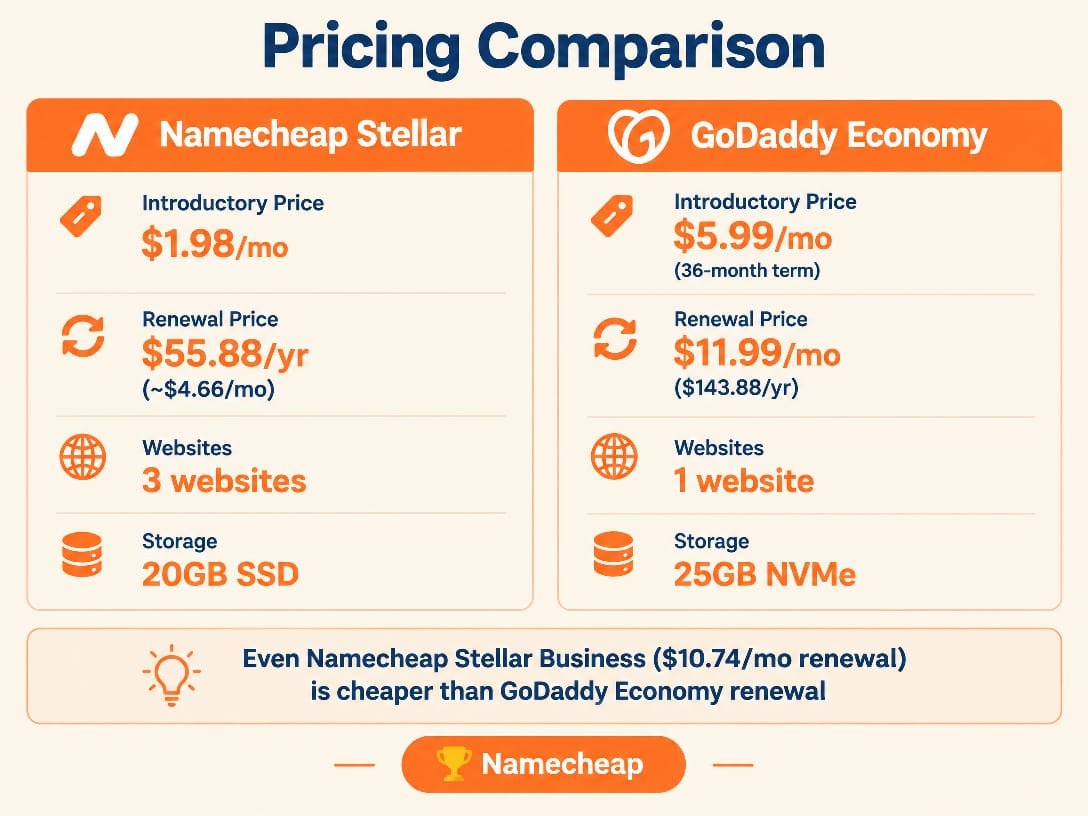
On GoDaddy’s official web-hosting page at the time of research, the Economy plan displays $6.99 per month on a 1-year term, renewing at $11.99 per month. The Deluxe plan shows $9.99 per month on a 1-year term, renewing at $16.99 per month. The Ultimate plan showed $12.99 per month on a 36-month term, renewing at $21.99 per month.
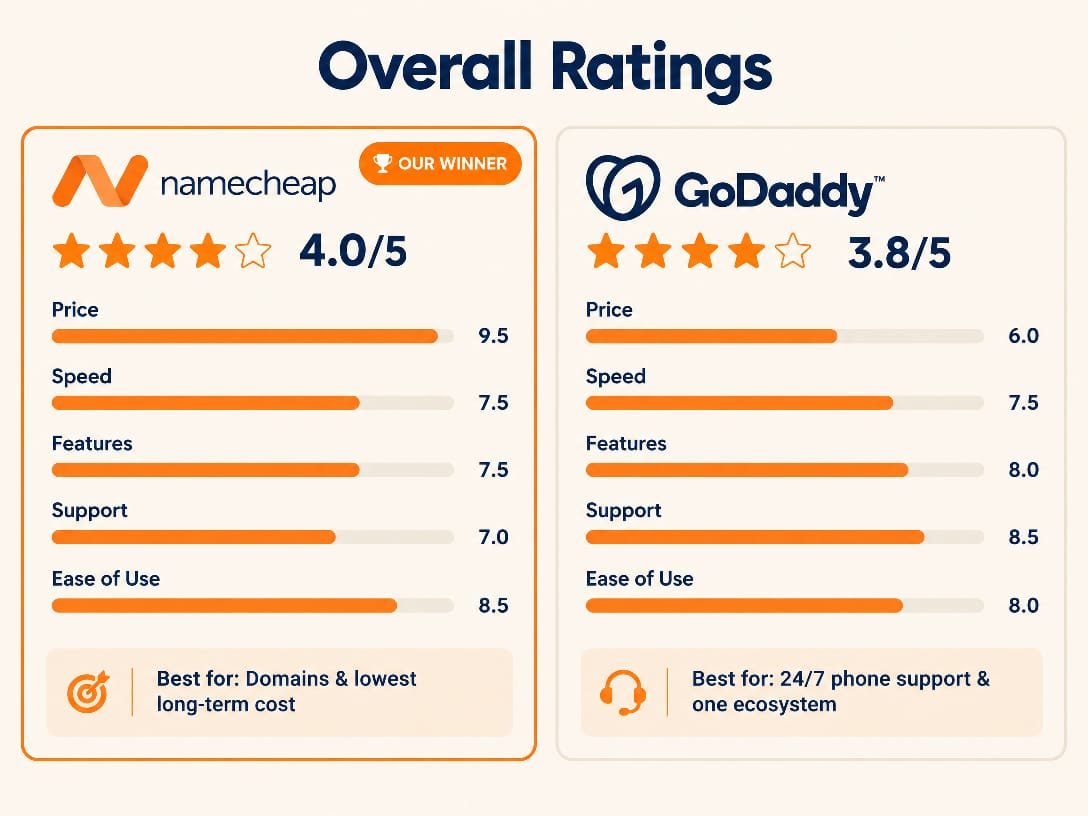
The pricing gap is significant at both the introductory and renewal stages. Namecheap’s Stellar plan is cheaper at entry and cheaper at renewal. Even Namecheap’s Stellar Business plan, which includes 50 GB SSD storage and unlimited everything else, renews at $10.74 per month, which is still less than GoDaddy Economy’s $11.99 renewal.
| Pricing and value | Namecheap Stellar | GoDaddy Economy |
|---|---|---|
| Displayed introductory price | $2.28/mo | $6.99/mo (1-year term) |
| Displayed renewal (yearly) | $55.88/yr (~$4.66/mo) | $11.99/mo ($143.88/yr) |
| Renewal price increase (May 2026) | Yes, announced by Namecheap | No new announcement |
| Websites | 3 | 1 |
| Storage | 20 GB SSD | 25 GB NVMe (selected plans) |
| Free domain | .link TLD, 1st year (verify at checkout) | 1st year on annual plans |
| Free SSL | Let’s Encrypt, auto-renewing | Free, no renewal fees |
| Domain privacy | Free (WhoisGuard) | Free for eligible TLDs |
| Backups | Weekly (Stellar) | Daily (Ultimate and higher only) |
Pricing winner: Namecheap for both introductory and renewal value. Namecheap’s Stellar plan costs less at entry, less at renewal, and includes three websites versus GoDaddy Economy’s one. GoDaddy’s advantage is NVMe storage on selected plans and a broader service ecosystem, but the price gap is hard to overlook for budget-focused buyers.
Performance and server technology
Both Namecheap and GoDaddy use Apache web servers with cPanel for their traditional shared hosting. Neither uses LiteSpeed, which means neither has the built-in LiteSpeed caching that hosts like Hostinger or SiteGround offer. This is an important distinction: if you prioritize server-level caching and PHP optimization, neither Namecheap nor GoDaddy’s shared hosting is the strongest option on the market.
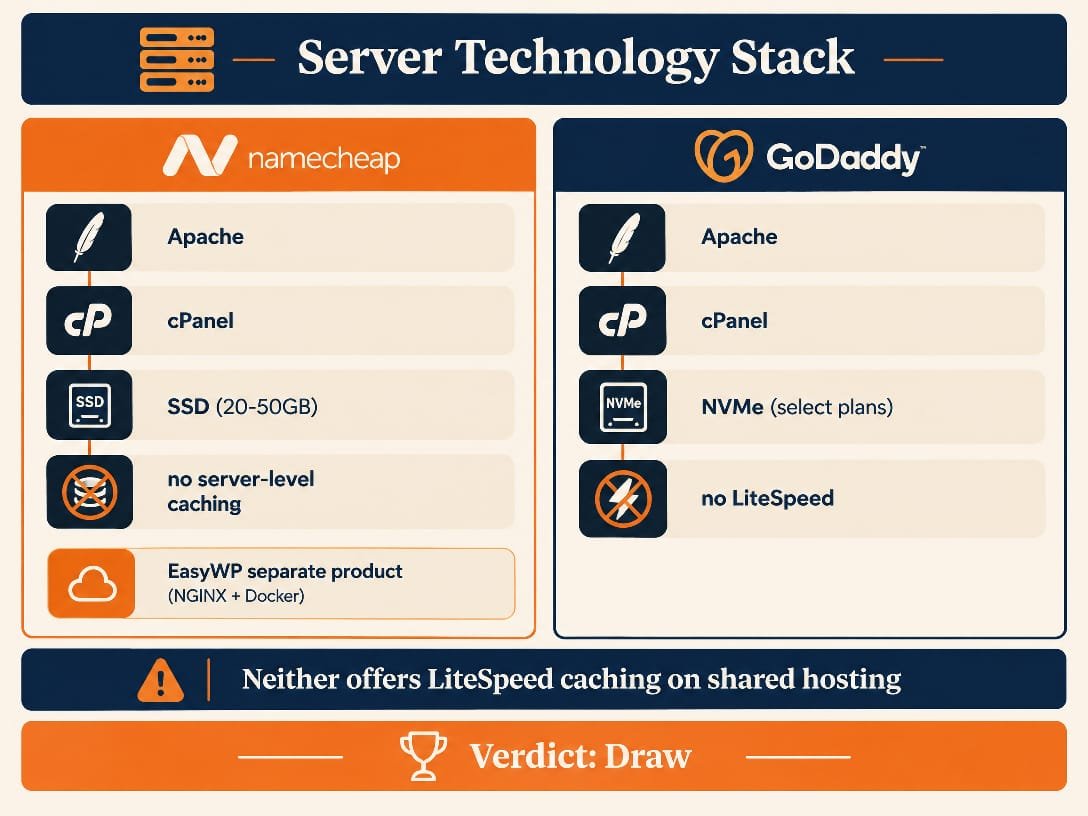
Storage differs. Namecheap uses standard SSD storage across all shared plans, from 20 GB on Stellar to 50 GB on Stellar Business. GoDaddy advertises NVMe storage on selected plans, which can deliver faster read-write speeds for disk-intensive operations. NVMe is not magic: web-server software, caching configuration, CPU limits, and database performance all influence real load times. But NVMe is a genuine hardware advantage when the rest of the stack is comparable.
Namecheap also offers EasyWP, a separate managed WordPress hosting product that uses NGINX and Docker instead of Apache and cPanel. EasyWP is not the same product as Namecheap’s shared hosting, but it is worth knowing about if you specifically want WordPress optimized hosting from Namecheap without cPanel overhead.
Performance winner: Draw. GoDaddy has an edge with NVMe storage on select plans, but neither provider offers LiteSpeed or server-level caching on shared hosting. For WordPress-specific performance, Namecheap’s EasyWP is a separate product worth considering at its own price point.
Features and everyday usability
Namecheap’s shared hosting includes cPanel, 1-click WordPress installation via Softaculous, free Let’s Encrypt SSL certificates that auto-renew, free domain privacy protection (WhoisGuard), and unmetered bandwidth on all plans. The Stellar plan includes 3 hosted domains, 30 email accounts, and 50 MySQL databases. Stellar Plus and Stellar Business include unlimited domains, email accounts, and databases.
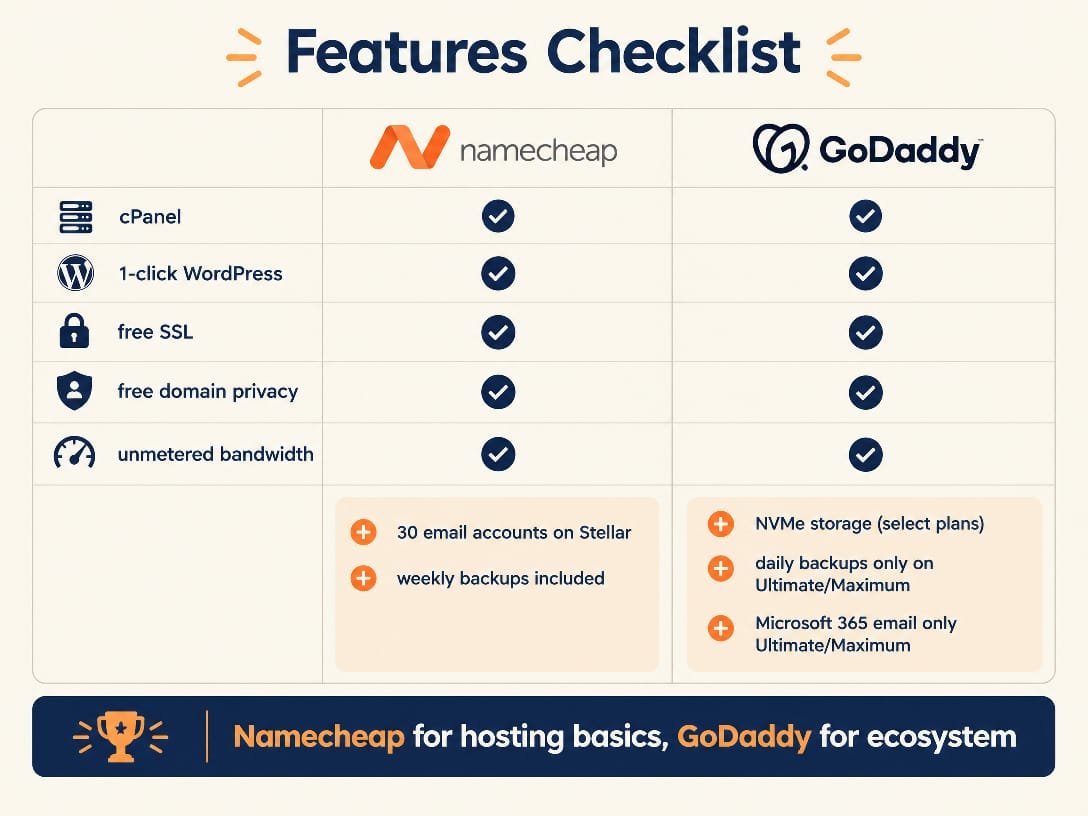
GoDaddy’s shared hosting includes cPanel, 1-click WordPress installation, free SSL with no renewal fees, a free domain for the first year on annual plans, and unmetered bandwidth. GoDaddy Economy includes 1 website and 25 GB storage. Deluxe includes unlimited websites and 50 GB. GoDaddy also bundles its website builder, marketing tools, and payment processing into the broader ecosystem.
Both providers offer free domain privacy protection for eligible domains. This was historically a differentiator because GoDaddy used to charge for domain privacy, but both now include it free for eligible TLDs. The remaining difference is that Namecheap’s WhoisGuard has been free for years and is applied automatically, while GoDaddy’s free privacy is newer and depends on the TLD.
Features winner: Namecheap for hosting basics, GoDaddy for ecosystem. Namecheap includes more for less: more websites, more email accounts, and auto-renewing SSL at a lower price. GoDaddy’s advantage is its broader product suite: website builder, marketing tools, GoDaddy Payments, and professional email all live under one account. If you want everything in one place, GoDaddy is more convenient. If you want the best hosting value, Namecheap wins.
Backups, email, domain, and security details
Backups are where the two providers diverge in ways that matter. Namecheap includes free automatic weekly backups on the Stellar plan. Stellar Plus adds AutoBackup with more frequent retained backups. GoDaddy includes daily backups only on its Ultimate and Maximum plans, not on Economy or Deluxe. If backups are important to you and you are considering GoDaddy Economy, you would need to add a backup solution separately or upgrade to a higher tier.
Email is another difference. Namecheap’s Stellar plan includes 30 email accounts. GoDaddy includes free Microsoft 365 email for one year on its Ultimate and Maximum plans, but Economy and Deluxe do not include free email. Namecheap’s email is a standard webmail product, while GoDaddy’s Microsoft 365 integration is more powerful but only available on higher tiers.
Both providers include free SSL certificates. Namecheap uses Let’s Encrypt, which auto-renews through cPanel at no cost. GoDaddy also offers free SSL with no renewal fees on current hosting plans. Both also include free domain privacy protection for eligible TLDs.
For security, both providers offer two-factor authentication for account access. Namecheap does not include free malware scanning on shared plans. GoDaddy includes baseline DDoS protection and standard security features, but advanced malware scanning and remediation typically require paid add-ons on both platforms.
Backups and email winner: Namecheap. Namecheap includes weekly backups and 30 email accounts on its cheapest plan. GoDaddy reserves daily backups and free email for its higher tiers, leaving Economy buyers without either unless they pay extra.
Data centers and visitor geography
Namecheap operates data centers primarily in the United States (Phoenix, Arizona) and the United Kingdom. This is a smaller footprint than most competitors. If your audience is in North America or the UK, Namecheap’s locations are adequate. If your visitors are in Asia, Australia, or South America, latency may be higher than with hosts that have data centers in those regions.
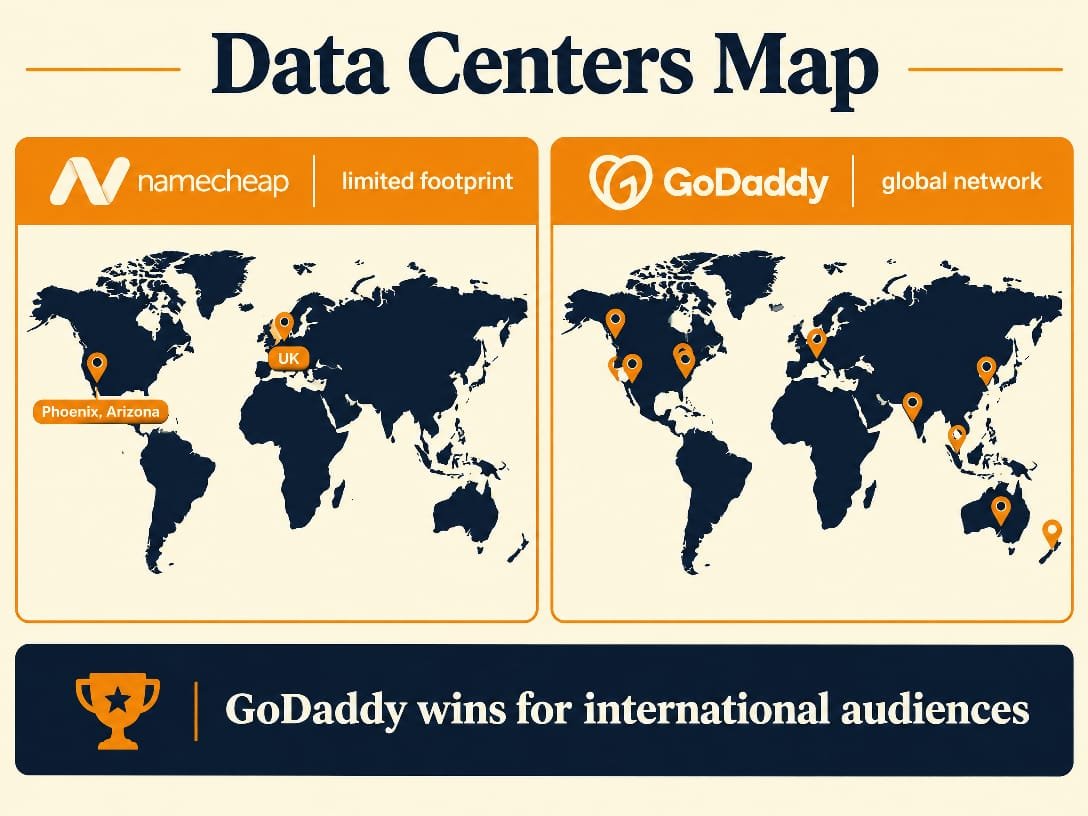
GoDaddy operates a larger global data center network with regionally optimized locations. This gives GoDaddy an advantage for international audiences, as you can choose a data center closer to your visitors. GoDaddy’s global infrastructure is one of its genuine advantages over smaller hosting providers.
Data center winner: GoDaddy. GoDaddy’s global data center network provides better geographic coverage for international audiences. Namecheap’s US and UK locations are sufficient for many sites but limited compared to GoDaddy’s reach.
Support, control panels, and ease of use
Namecheap offers 24/7 live chat support and ticket-based support. There is no phone support. For many users, live chat is sufficient, but complex issues can take longer to resolve through chat and tickets than through a phone call. Namecheap’s support agents are generally knowledgeable about hosting and domain issues, and the platform provides extensive documentation and tutorials.
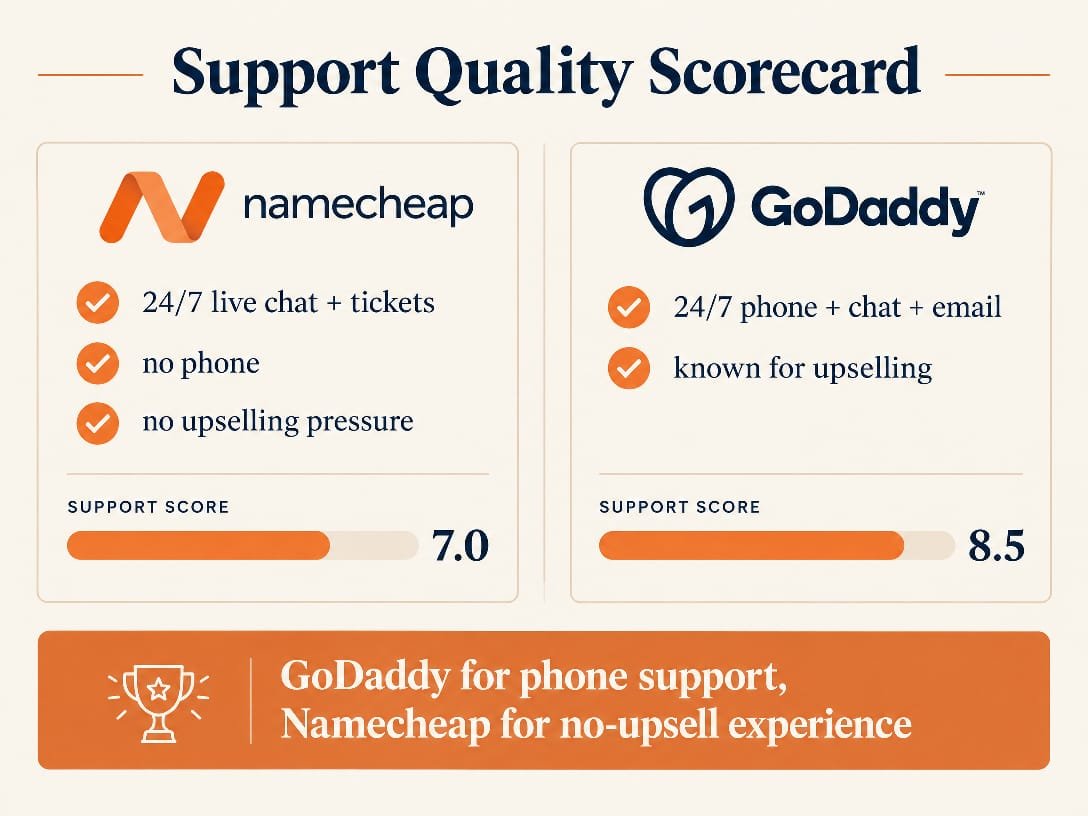
GoDaddy offers 24/7 phone support, live chat, and email support. Phone support is a genuine differentiator, especially for users who are new to hosting and prefer talking through issues with a human. However, GoDaddy’s support agents are known for upselling additional services during support interactions, which some users find frustrating.
Both providers use cPanel, so the control panel experience is similar. Namecheap’s cPanel is standard and unmodified. GoDaddy’s cPanel is also standard, though GoDaddy has been integrating more of its own tools and branding into the dashboard. Both offer 1-click WordPress installation via Softaculous or similar tools.
Support winner: GoDaddy for phone support, Namecheap for no-upsell experience. GoDaddy’s 24/7 phone support is a real advantage for users who want human assistance. Namecheap’s chat-only support is adequate but slower for complex issues. However, Namecheap’s support is free of upselling pressure, which many users prefer.
What the top comparison pages get right, and what they miss
We reviewed the first five prominent organic results for “Namecheap vs GoDaddy” to see what they cover and what they leave out. Here is our analysis:
CrazyEgg provides a balanced pros and cons comparison covering domains, hosting, support, and ease of use. Their conclusion that Namecheap is cheaper while GoDaddy offers broader tooling is correct. However, they do not show specific renewal pricing tables, do not mention Namecheap’s May 2026 price increase, and do not compare server technology or backup policies between plans. They also note that neither provider made their best hosting list, which is a fair assessment.
Namecheckly focuses primarily on domain registration pricing rather than hosting. Their observation that Namecheap has lower renewal fees and includes free WHOIS privacy is accurate. However, their hosting comparison is thin, with no plan-level pricing breakdown, no backup analysis, and no server technology details. Buyers comparing hosting specifically will need more than this article provides.
Reddit discussions on r/webdev and r/hosting tend to favor Namecheap for domain registration and budget hosting, with some users recommending Hostinger as a third option for simpler management. These discussions are anecdotal and lack structured pricing comparisons. They also do not reflect the May 2026 renewal price changes at Namecheap.
HostingSeekers covers basic hosting comparison points but lacks the renewal pricing detail needed for a real buying decision. Their feature comparison does not differentiate between backup policies across plan tiers, which is a critical omission given that GoDaddy does not include daily backups on Economy.
ForwardEmail compares Namecheap and GoDaddy specifically for email services, not hosting. While useful for email-focused buyers, it does not address shared hosting pricing, server technology, or performance.
What we add that they miss: specific renewal pricing from official sources (including Namecheap’s May 2026 increase), backup policy differences across plan tiers, server technology comparison (both Apache, but GoDaddy NVMe vs Namecheap SSD), and the total cost of ownership after year one.
Pros and cons: final comparison
Where Namecheap is stronger
- Lower introductory pricing: Stellar from $2.28/mo.
- Lower renewal pricing: Stellar renews at $55.88/yr (~$4.66/mo).
- Three websites on the Stellar plan versus GoDaddy Economy’s one.
- Free domain privacy (WhoisGuard) applied automatically.
- Free Let’s Encrypt SSL that auto-renews through cPanel.
- Weekly backups included on the cheapest plan.
- 30 email accounts on the Stellar plan at no extra cost.
- EasyWP managed WordPress as a separate optimized product.
Where GoDaddy is stronger
- 24/7 phone support, not just chat and tickets.
- NVMe storage on selected plans for faster disk performance.
- Global data center network for better international coverage.
- Daily backups on Ultimate and Maximum plans.
- Free Microsoft 365 email on Ultimate and Maximum plans.
- Broader ecosystem: website builder, marketing tools, and GoDaddy Payments.
- Larger registrar with 21 million customers and public company stability.
Both providers use cPanel and Apache, so the control panel experience is similar. The real differences are price, support, backups, and ecosystem. Namecheap wins on cost and included features at the shared-hosting level. GoDaddy wins on support options, global infrastructure, and the convenience of having everything under one account if you use its other products.
Which one should you choose?
Choose Namecheap if: you want the best value for shared hosting, you are budget-conscious, you do not need phone support, your audience is primarily in the US or UK, and you want free domain privacy, weekly backups, and multiple websites at a low price. Namecheap is the clear winner for buyers who prioritize cost and straightforward hosting.
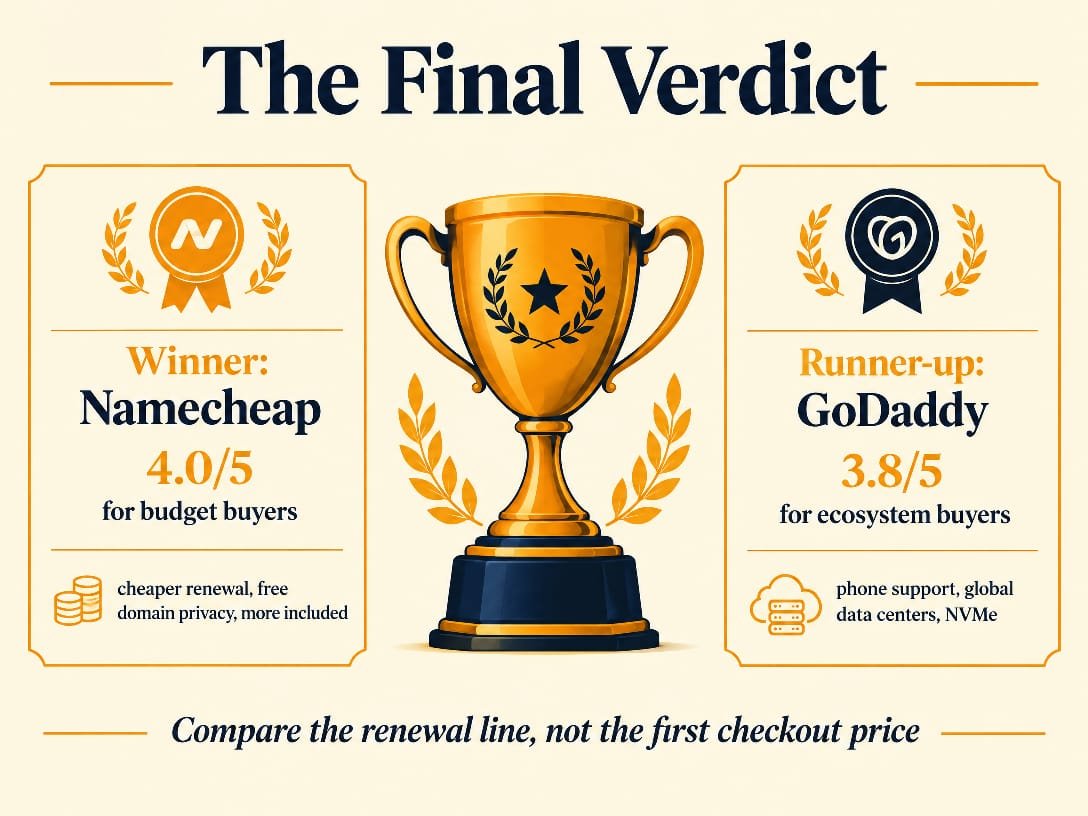
Choose GoDaddy if: you want 24/7 phone support, you value having your domain, hosting, email, website builder, and payment processing in one account, you need NVMe storage, or your audience is international and benefits from GoDaddy’s global data centers. GoDaddy is the better choice for buyers who want a full-service business platform and are willing to pay more for it.
Choose neither if: you want the fastest hosting experience. Both use Apache, not LiteSpeed, and neither offers server-level caching on shared plans. If performance is your top priority, consider Hostinger (LiteSpeed, NVMe) or SiteGround (LiteSpeed, NVMe) instead. See our comparison of Hostinger vs GoDaddy for a performance-focused alternative.
Frequently asked questions
Is Namecheap better than GoDaddy for web hosting?
Which is cheaper, Namecheap or GoDaddy?
Does Namecheap or GoDaddy offer free domain privacy?
Do both providers use cPanel?
Does GoDaddy include daily backups on all plans?
Did Namecheap raise its renewal prices in 2026?
Which provider has phone support?
Migration, growth, and total cost after year one
The total cost of ownership after the first year is where the two providers diverge most sharply. A buyer on Namecheap’s Stellar plan pays roughly $23.76 for the first year at the introductory rate, then $55.88 per year on renewal. A buyer on GoDaddy Economy pays $83.88 for the first year ($6.99 x 12 months), then $143.88 per year on renewal ($11.99 x 12). Over a three-year horizon, Namecheap costs approximately $135, while GoDaddy costs approximately $216 plus the renewal year.
For migration, Namecheap includes free site migration assistance on shared hosting plans. GoDaddy also offers migration services, though the terms vary by plan and whether WordPress or a custom site is involved.
For growth, both providers offer VPS and dedicated server options. Namecheap’s VPS and dedicated server pricing is aggressive and worth considering if you outgrow shared hosting. GoDaddy’s VPS plans are more expensive but include managed options and tighter integration with its ecosystem. If you expect to scale quickly, compare the VPS pricing at both providers before committing.
The honest summary: Namecheap is the better hosting value, GoDaddy is the better business platform. Choose based on which problem you are solving.
Sources and research notes
Official pricing and feature pages reviewed: Namecheap shared hosting, Namecheap shared hosting pricing changes (May 2026), Namecheap shared hosting plans comparison, GoDaddy web hosting, and GoDaddy pricing. Competitor comparison pages reviewed include CrazyEgg, Namecheckly, HostingSeekers, and Reddit discussions. Prices and included features are a September 2026 snapshot and should be rechecked at checkout.