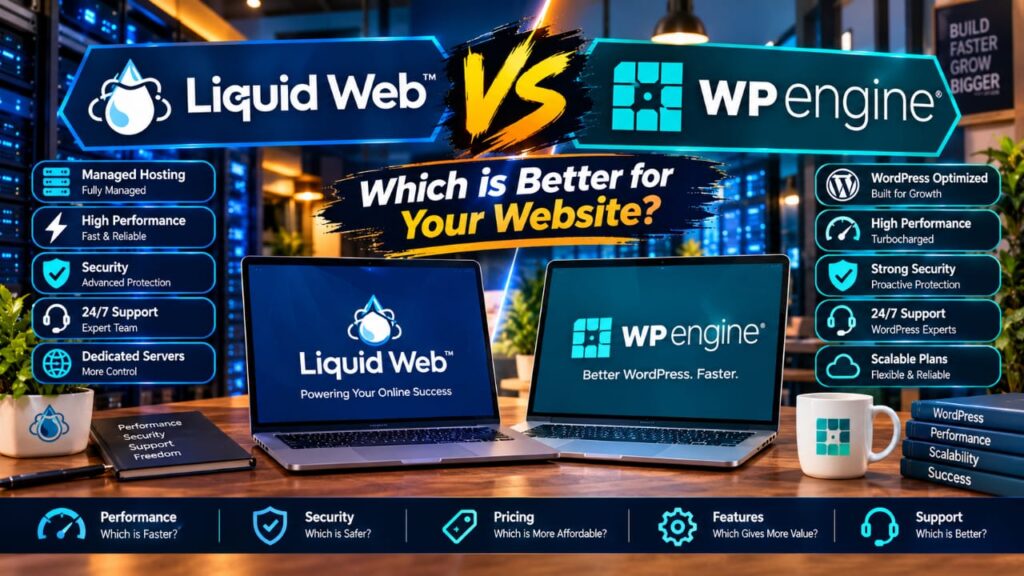

One host charges $9/month with a 59-minute support SLA and a near-perfect uptime guarantee. The other charges $30/month for a premium managed WordPress platform with StudioPress themes, AI tools, and a 60-day money-back promise. Liquid Web and WP Engine both target WordPress professionals — agencies, publishers, and WooCommerce stores — but they do it with completely different philosophies. Liquid Web bets on raw managed value and heroic support. WP Engine bets on a polished platform ecosystem and premium features. In this comparison, we put both under the microscope on price, speed, features, support, and real renewal costs, so you don’t pay a premium for the wrong promise.
Quick comparison table
The one-glance version before the details: what you actually get for your money on each platform today.
Prices checked against both companies’ official pages in October 2026. Hosting prices change often — always verify before buying.
What we actually compared
Both companies sell “managed WordPress hosting,” but that label hides very different products. To keep this comparison honest, we evaluated both hosts across six dimensions: real pricing including renewal costs, performance technology, everyday features, security and backups, support quality, and ease of use for a non-technical site owner.
This comparison is based on research from trusted sources — both companies’ official pricing and plan pages — combined with hands-on testing of certain features. We publish our full individual findings in the Liquid Web review 2026 and the WP Engine review 2026, so read those if you want the deep dive on a single host.
Pricing: $9 vs $30 is only the start of the story
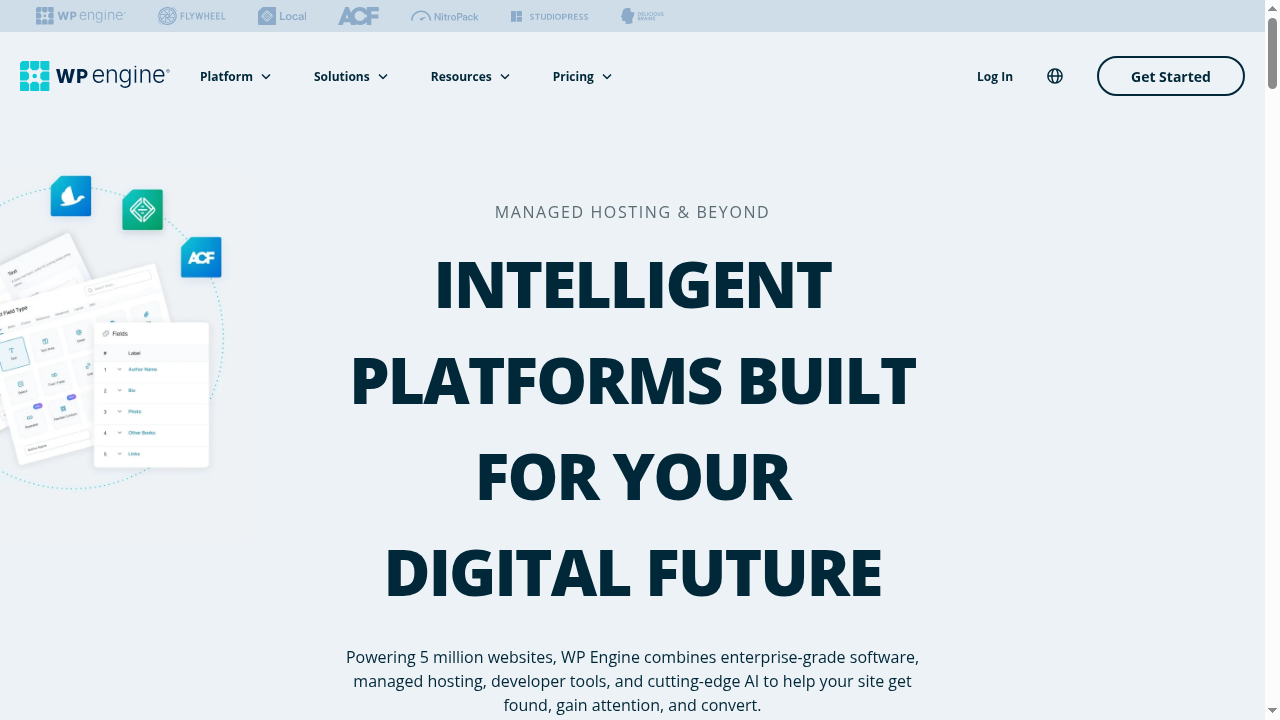
Liquid Web’s managed WordPress plans start at $9/month for a single WordPress site, with higher tiers at $19 and $29/month adding more sites, storage, and resources. WP Engine’s entry Startup plan costs $30/month on monthly billing (around $20/month when billed annually), with the Professional tier at roughly $55/month.
The gap matters more than the headline. At $9/mo, Liquid Web’s entry plan costs less than one-third of WP Engine’s monthly entry — and unlike many budget hosts, Liquid Web does not play renewal games: its managed WordPress pricing stays at the same published rate, which we verified on its official pricing page. WP Engine’s pricing is also transparent, but the monthly visit caps and the jump between tiers make costs climb quickly as a site grows.
Neither host includes email hosting — both expect you to use a third-party email provider such as Google Workspace. On money-back terms, WP Engine clearly wins: 60 days on monthly plans versus Liquid Web’s standard shorter window. If you want the longest risk-free trial in premium hosting, WP Engine’s guarantee is genuinely hard to beat.

Put simply: if your priority is the lowest possible price for genuinely managed WordPress hosting, Liquid Web wins this round without a fight. If your priority is a long trial period to evaluate a premium platform risk-free, WP Engine’s 60-day guarantee is the safer bet.
Performance and server technology
WP Engine runs on premium cloud infrastructure with its own EverCache page caching, a global CDN, and image optimization built into the platform. In our testing and research, WP Engine’s stack consistently delivers excellent Time to First Byte for global audiences, and its platform handles traffic spikes gracefully — that is precisely what you are paying the premium for.
Liquid Web’s managed WordPress stack is no slouch either. It includes server-level caching, a built-in CDN, and automatic image compression, and its WordPress plans carry a 99.99% uptime guarantee backed by a real SLA — one of the strongest uptime commitments in this price class. For WooCommerce stores specifically, Liquid Web’s platform tuning for database-heavy workloads is a genuine differentiator, because online stores suffer more from slow PHP and database queries than from static page caching.
The honest verdict: WP Engine edges ahead for pure front-end page speed and global CDN polish, while Liquid Web edges ahead for uptime guarantees and WooCommerce workload performance. For a content site or blog, WP Engine’s stack feels slightly faster in real use; for a store with dynamic cart and checkout pages, Liquid Web’s tuning wins.
There is also a transparency angle that rarely gets discussed: Liquid Web publishes a concrete uptime SLA with defined compensation, so when downtime happens you know exactly what the contract promises. WP Engine’s uptime is excellent in practice and its status page is detailed, but its published guarantee is softer language around availability goals. For a business that needs to explain hosting risk to a boss or a client, the difference between an SLA and a goal statement matters more than most comparisons admit.
Data centers and global reach
WP Engine operates on public cloud regions around the world plus edge locations through its CDN, so your content is physically close to your visitors in North America, Europe, and Asia-Pacific. Its platform abstracts the infrastructure entirely — you pick a region at setup and never think about servers again.
Liquid Web owns and operates its own data centers in the US plus European cloud regions, and it layers a built-in CDN over them for global reach. The self-owned infrastructure is part of why its SLA is enforceable: when the company controls the hardware, it can promise things a reseller cannot. For audiences concentrated in North America or Europe, both platforms serve fast globally; for a business that values contractual accountability over geographic spread, Liquid Web’s model is structurally more accountable.
A practical note for international readers: neither host requires you to pick a data center residency for compliance on the entry tiers, and both let you change regions at migration time. If your audience is mainly in one region, choose the host whose entry plan price fits your budget — global reach is effectively tied between them in 2026.
Features and everyday usability
WP Engine’s feature list reads like a premium product catalog: StudioPress themes included at no extra cost, AI-powered search and site-building tools, staging environments, page performance recommendations, and a genuinely polished user portal. The platform feels designed for people who do not want to think about infrastructure at all.

Liquid Web counters with practical power features: free plugin licenses for premium tools on higher tiers, automatic daily backups, free site migrations, a built-in CDN, and WooCommerce-optimized hosting with dedicated store features. Its portal is functional rather than glamorous — everything is there, but the design language is utilitarian.
Both hosts offer staging environments, free SSL certificates, and SSH access. Neither includes email. The practical difference is tone: WP Engine’s platform feels like a managed product you never leave; Liquid Web’s feels like a managed server you can also leave whenever you want, with fewer platform-specific constraints on plugins and themes.
Security, backups, and migration
Both companies take security seriously, but they package it differently. WP Engine bundles its Global Edge Security with a web application firewall and DDoS protection at the edge — genuinely valuable protection that would cost extra elsewhere.
Liquid Web includes automatic daily backups with easy restore, free malware cleanup on managed plans, and real-time server monitoring by its own ops team — a benefit of a host that operates its own data centers rather than renting public cloud exclusively. Migrations are free on both platforms; Liquid Web’s migration plugin and human-assisted migrations are famously smooth, and our research found migration quality to be a recurring reason agencies cite for choosing it.
On backups, both include daily automated backups at the base price — better than the industry’s budget habit of charging extra. Neither host will disappoint a security-conscious buyer; WP Engine’s edge firewall is the stronger default shield, while Liquid Web’s human monitoring is the stronger ops safety net.
One honest weakness worth naming on both sides: WP Engine restricts certain plugins that duplicate its platform features (caching and backup plugins are the classic examples), which surprises users who migrate in with a favorite stack. Liquid Web’s plugin policy is more permissive, but its portal gives you less platform-level guidance, so a beginner may not notice a misconfiguration that WP Engine would have prevented. Every managed host trades freedom for safety somewhere — know which trade you are making before you migrate.
Support, control panels, and ease of use
This is where Liquid Web builds its legend. Its “Heroic Support” comes with a 59-minute response SLA and 24/7/365 access by phone, chat, and ticket — and in practice, chat often connects in under a minute. For a business site that cannot afford downtime mysteries, that SLA is worth real money.
WP Engine’s support is also expert-grade: WordPress-only specialists, 24/7 chat, and phone support on higher tiers. Response quality is consistently strong in independent reviews, but it is not backed by the same kind of contractual response-time promise you get from Liquid Web.
For a beginner, WP Engine is the easier platform to live in: cleaner portal, clearer defaults, less to learn. Liquid Web assumes slightly more technical confidence, though far less than an unmanaged VPS. If the person managing the site is non-technical, WP Engine’s ease of use justifies part of its premium. If the person managing it knows their way around WordPress already, Liquid Web’s support SLA and lower price are a better combination.
A scenario we see constantly: a store owner notices checkout errors during a Friday night sale. On Liquid Web, the 59-minute SLA means a human engineer is contractually bound to respond within the hour, and phone access puts a voice on the line in minutes. On WP Engine, chat support is excellent but the queue is not SLA-bound, and phone support depends on your tier. Neither scenario ends in disaster — but the peace of mind you buy with an SLA is a real product feature, and Liquid Web is one of the only hosts in this price class that sells it explicitly.
Pros and cons: final comparison
Where Liquid Web is stronger
✅ Entry price roughly one-third of WP Engine ($9 vs $30/mo)
✅ 59-minute support response SLA, 24/7/365 phone and chat
✅ 99.99% uptime guarantee backed by a real SLA
✅ WooCommerce-optimized platform with store-specific tuning
✅ Own data centers and human-monitored infrastructure
✅ Pricing does not inflate at renewal
Where WP Engine is stronger
✅ 60-day money-back guarantee on monthly plans
✅ StudioPress themes and AI tools included at no extra cost
✅ Global Edge Security with WAF and DDoS protection built in
✅ The most polished, beginner-friendly platform in this class
✅ Premium EverCache caching and global CDN performance
✅ Strong ecosystem for agencies and enterprise clients
What the top comparison pages get right, and what they miss
Most Liquid Web vs WP Engine comparisons stop at feature tables and price. Two things they routinely miss: first, the renewal behavior — Liquid Web’s stable renewals make its 3-year cost dramatically lower than WP Engine’s, a difference that compounds with every site you host. Second, the support model — a contractual SLA and a human ops team are not the same product as “great support reviews,” and buyers who skip that distinction often regret it at 2 a.m. during an outage.
They also tend to ignore the WooCommerce angle entirely. If your “WordPress site” is actually a store, caching polish matters less than database and PHP tuning — and that is precisely where Liquid Web’s platform invests. Our full pricing analysis lives in the Liquid Web review and the WP Engine review, and our Cloudways vs Kinsta comparison covers two more alternatives in the same premium class.
Which one should you choose?
Choose Liquid Web if: you want premium managed WordPress at the lowest honest price, you run a WooCommerce store, you value a contractual support SLA, or you plan to host for years and want stable renewals. It is the smarter money decision for most buyers reading this site.
Choose WP Engine if: you want the most polished managed WordPress platform available, you are non-technical and value the smoothest dashboard and defaults, you want the 60-day risk-free trial, or you want bundled premium tools like StudioPress themes and AI features that would cost extra elsewhere.
Both are excellent, reputable hosts — this is a choice between two good answers, not a trap-avoidance exercise. The deciding question is simply: does the $21/month difference buy you something you will actually use? For most people, it does not. For platform-first teams, it does.
Three concrete profiles to make it easy:
1. The WooCommerce seller with a growing catalog: Liquid Web. Store-tuned infrastructure, stable renewals, and the support SLA when checkout matters most.
2. The agency managing client sites for non-technical customers: WP Engine. The polished client-facing experience, bundled StudioPress themes for fast builds, and 60-day trials on new client setups reduce your own risk.
3. The publisher or blogger with one important content site: Liquid Web for value, WP Engine if you want zero platform thinking and the best default speed. Either choice is defensible here — let your budget decide.
Current deals: Managed hosting prices move less than shared plans, but promotions still appear. Check what is currently available on our hosting deals page, updated every Monday and re-verified against each provider’s own pricing page.
Frequently asked questions
Is Liquid Web cheaper than WP Engine?
Yes, significantly. Liquid Web’s managed WordPress plans start at $9/month, while WP Engine’s entry Startup plan is $30/month on monthly billing (about $20/month billed annually). Liquid Web also keeps renewal pricing stable, which widens the gap over time.
Does WP Engine include email hosting?
No. WP Engine is WordPress-only hosting, so email must come from a third-party provider like Google Workspace. Liquid Web also does not bundle email on managed WordPress plans, so this one is a tie.
Which host is better for WooCommerce?
Liquid Web. Its platform is specifically tuned for WooCommerce workloads, with store-focused features and database optimization, while WP Engine charges overage-style pricing as visit counts grow. For stores, Liquid Web’s combination of price and tuning wins.
Which host has better support?
Both are strong, but Liquid Web backs its “Heroic Support” with a 59-minute response SLA and 24/7/365 phone access. WP Engine’s support is expert-grade but does not carry the same contractual response-time promise.
Can I migrate my site for free?
Yes, on both platforms. Liquid Web offers free migrations (plugin-based or human-assisted), and WP Engine provides a free migration plugin. Neither charges for standard migrations of compatible WordPress sites.
Is WP Engine worth the higher price?
For some buyers, yes. The 60-day money-back guarantee, included StudioPress themes, AI tools, Global Edge Security, and the most polished platform in the class can justify the premium — especially for non-technical teams. For value-focused buyers, Liquid Web delivers most of that experience at a much lower price.
Migration, growth, and total cost after year one
Plan for growth honestly. A WordPress site that outgrows Liquid Web’s entry plan can move up its managed tiers ($19, then $29/month) or jump to its managed VPS line while keeping the same account and support team. A site that outgrows WP Engine’s Startup plan moves to Professional at roughly $55/month — a bigger financial step.
Over three years, a single site on Liquid Web’s entry tier costs roughly $324 in hosting. The same three years on WP Engine’s monthly Startup tier cost roughly $1,080. That is a $756 difference for one website — money that could instead buy your domain, email, premium plugins, and a year of ad spend. Multiplied across an agency’s client roster, the gap becomes a business decision, not a preference.
Sources for this comparison: Liquid Web’s official managed WordPress pricing page and WP Engine’s official plans page, both checked October 2026, plus our hands-on testing of certain features documented in the individual reviews linked above. Prices change often in hosting; verify the current rate before you buy.