The landscape of software as a service has undergone a seismic shift since the advent of large language models and generative AI. No longer is it enough to simply host software in the cloud; the modern market demands intelligence, automation, and predictive capabilities. AI SaaS product classification criteria serve as the backbone for investors and founders trying to navigate the complex landscape of modern software. By establishing clear definitions, stakeholders can distinguish between “hype” and genuine technological innovation.
1. The Core Architecture: AI-Native vs. AI-Enhanced
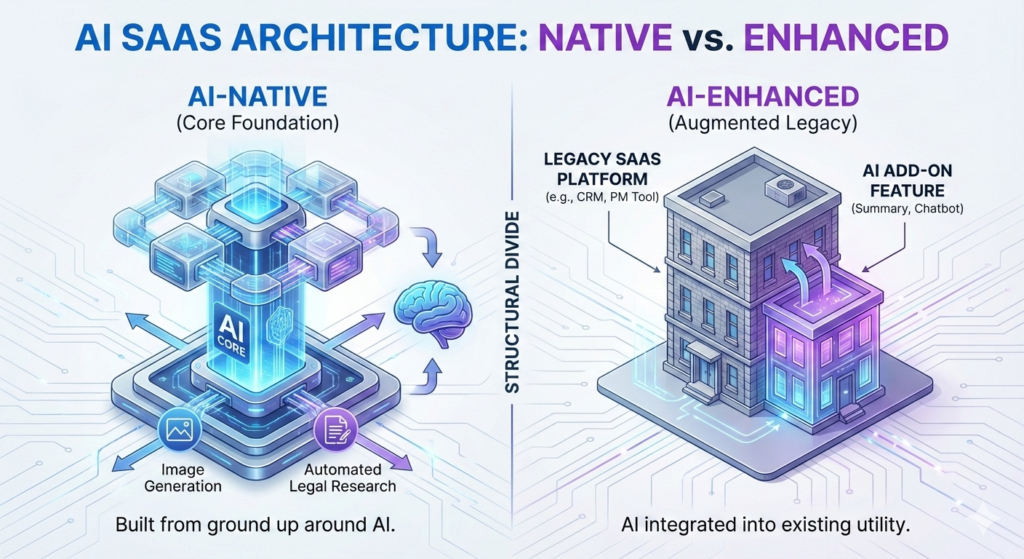
When we look at the structural foundation of a product, we see a clear divide in how AI is integrated. This is the first and most vital layer of any classification system.
AI-Native products are those built from the ground up with artificial intelligence as the central value proposition. If you were to remove the AI component, the product would cease to exist or lose 99% of its utility. Examples include image generation platforms or automated legal research tools. AI SaaS product classification criteria help distinguish between simple API wrappers and deep-tech platforms that offer long-term value.
On the other hand, AI-Enhanced (or Augmented) products are legacy SaaS platforms that have integrated AI features to improve user experience. Think of a project management tool that adds an AI summary feature. While helpful, the core utility—task tracking—remains functional even without the AI.
2. Horizontal vs. Vertical AI SaaS
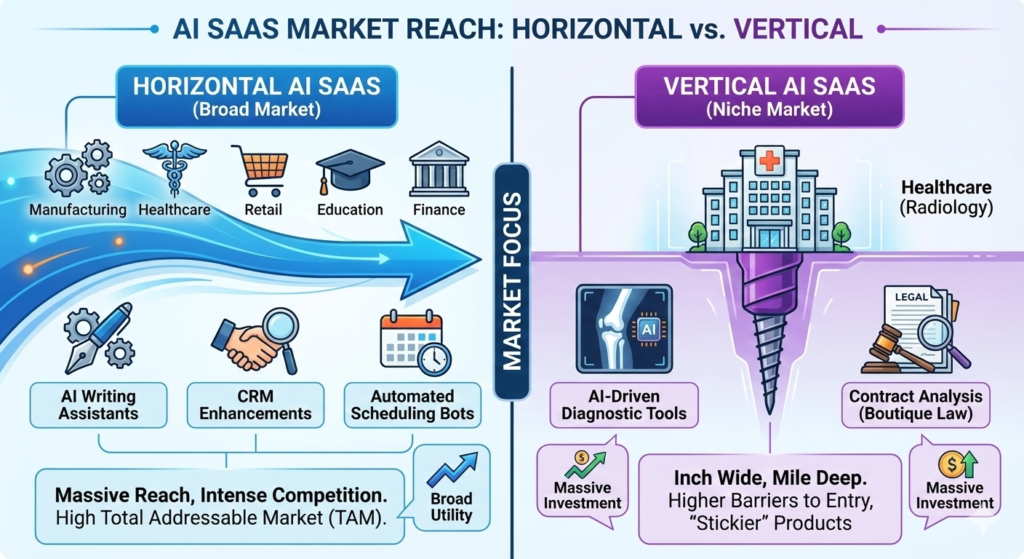
Understanding the market reach of a product is essential for evaluating its Total Addressable Market (TAM).
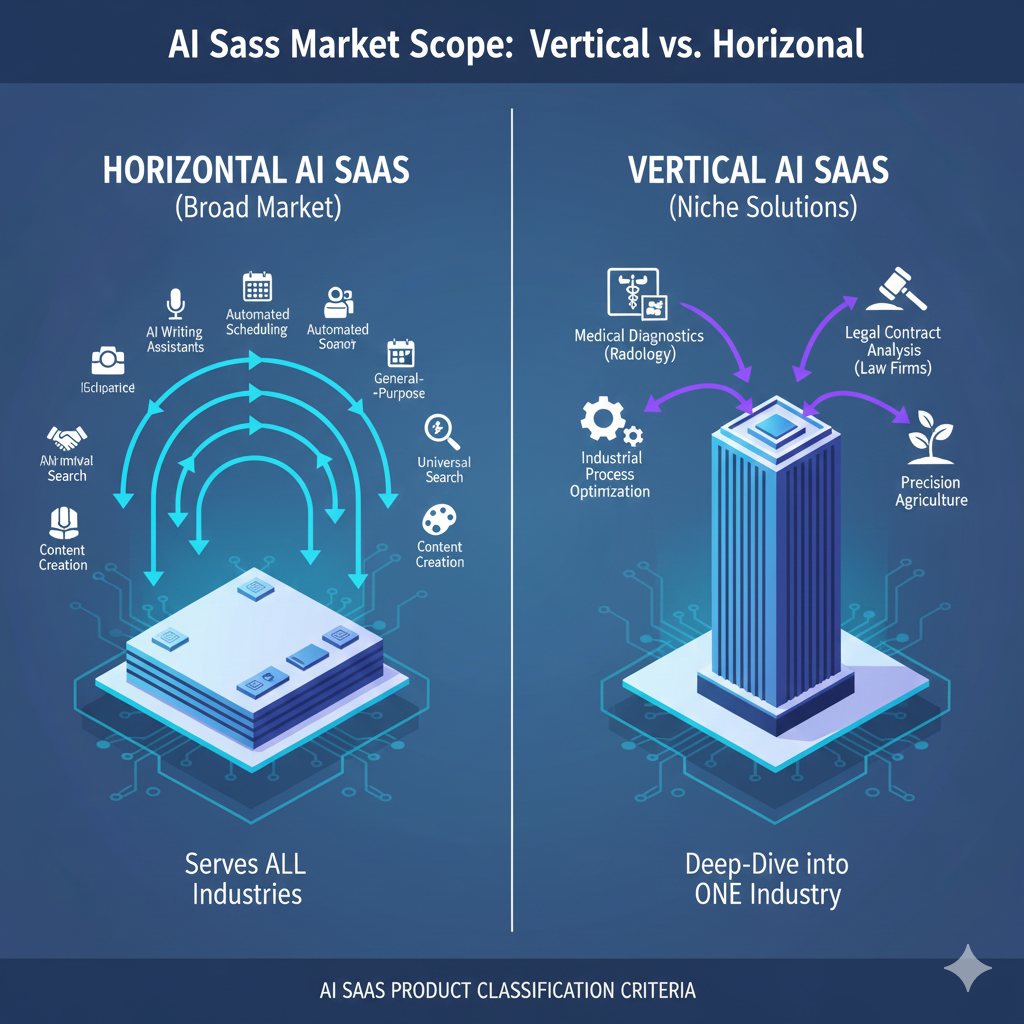
- Horizontal AI SaaS: These are tools designed to be used across any industry. Examples include AI writing assistants, general-purpose CRM enhancements, or automated scheduling bots. They have a massive reach but face intense competition.
- Vertical AI SaaS: These products are “inch wide and mile deep.” They solve specific problems for a single industry, such as AI-driven diagnostic tools for radiologists or contract analysis for boutique law firms.
AI SaaS product classification criteria allow us to categorize software based on whether it serves a broad market or a specific niche. Vertical AI is currently seeing massive investment because it creates “stickier” products with higher barriers to entry.
3. The “Wrapper” vs. Proprietary Model Debate
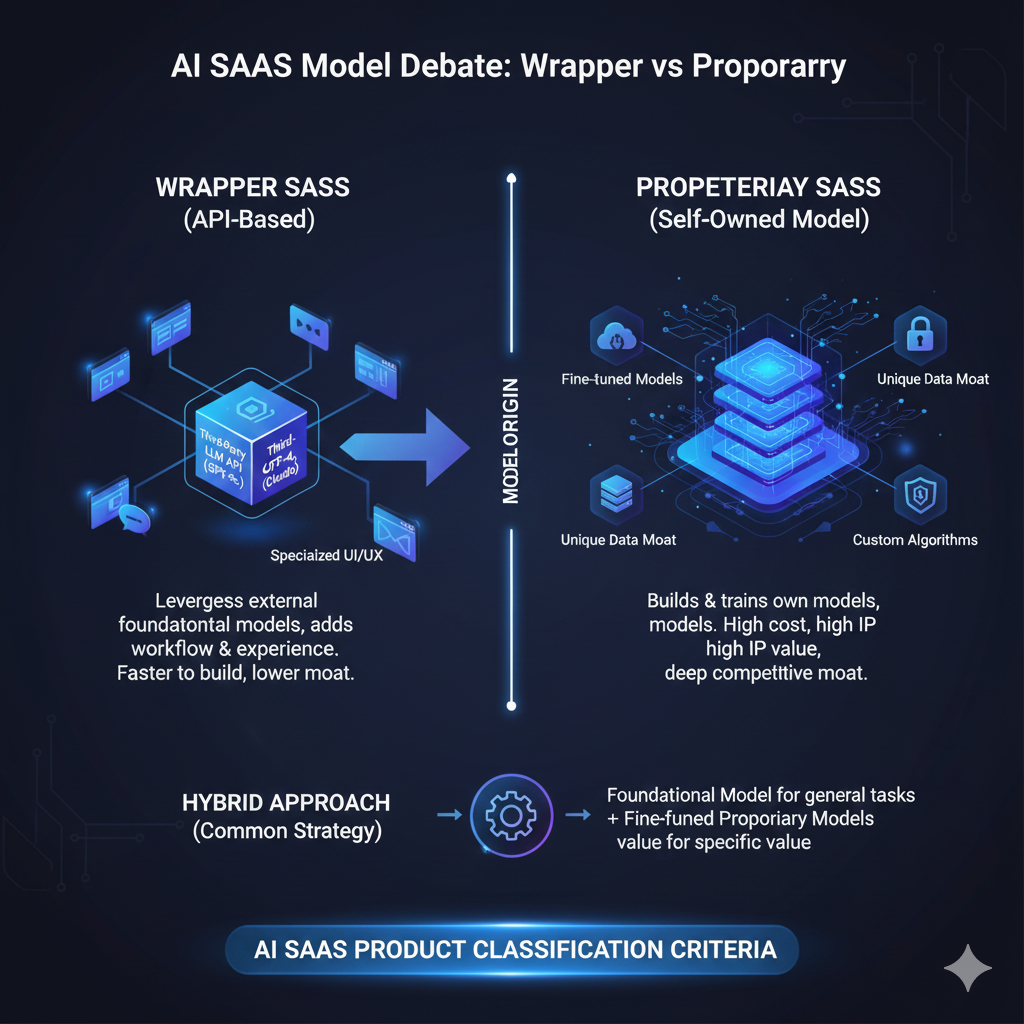
In the current ecosystem, many startups are built on top of third-party models like OpenAI’s GPT-4 or Anthropic’s Claude. These are often disparagingly called “wrappers.” However, a wrapper with a superior user experience (UX) and specialized workflow can still be a billion-dollar business.
AI SaaS product classification criteria should also account for how a model is deployed—whether on-premise, cloud, or edge. A company that trains its own proprietary models often has a higher valuation because they own the intellectual property. However, the cost of training these models is astronomical. Most successful AI SaaS companies today use a “hybrid” approach: utilizing a foundational model for general tasks while fine-tuning smaller, proprietary models for specific, high-value tasks.
Comparison Table: Classification Summary
| Criteria | Category A | Category B |
| Integration | AI-Native (Born in AI) | AI-Enhanced (Legacy + AI) |
| Market Scope | Horizontal (General) | Vertical (Industry-specific) |
| Model Type | Proprietary (Self-owned) | Wrapper (API-based) |
| Autonomy | Copilot (Assisted) | Agentic (Autonomous) |
4. Levels of Autonomy: Copilots vs. Agents
The way users interact with AI is shifting from “doing the work with help” to “delegating the work entirely.” This transition is a major factor in how we classify modern software.
- Copilots: These require a human-in-the-loop. The AI suggests, but the human decides.
- Agents (Agentic AI): These are autonomous systems that are given a goal and determine the steps to achieve it without constant human supervision.
AI SaaS product classification criteria categorize autonomy into distinct levels, ranging from human-in-the-loop to fully autonomous agents. As we move toward 2026, the industry is trending heavily toward “Agentic” workflows where the software acts as a virtual employee rather than just a tool.
5. The Importance of the “Data Moat”
In the world of AI, the winner isn’t necessarily the one with the best code, but the one with the best data. A “Data Moat” refers to a competitive advantage gained by having access to unique, high-quality data that competitors cannot easily replicate.
AI SaaS product classification criteria must evaluate the “data moat” of a startup to predict its sustainability. If a product trains on public data, it is easily disrupted. If it trains on proprietary customer feedback loops and private datasets, it becomes increasingly difficult to replace. This creates a “flywheel effect”: more data leads to a better model, which attracts more users, who then generate more data.
6. Evolving Pricing Models
Traditional SaaS relied on “per-seat” pricing. However, AI changes the unit economics of software. Since AI tasks require significant GPU compute power, charging per user often doesn’t make sense if one user runs 10,000 queries and another runs ten.
AI SaaS product classification criteria are shifting as compute costs force companies to move away from traditional per-seat pricing. We are seeing a rise in:
- Consumption-based pricing: Paying per token, per image, or per task.
- Value-based pricing: Paying based on the money saved or revenue generated (e.g., an AI that recovers lost taxes taking a % of the recovery).
7. Security, Compliance, and Ethics
As AI handles more sensitive data, the criteria for classification must include security standards. Enterprise-grade AI must offer SOC2 compliance, data encryption, and “zero-retention” policies to ensure that customer data isn’t used to train the base models of competitors.
AI SaaS product classification criteria now include rigorous standards for data privacy and ethical AI usage. Companies that can guarantee “Sovereign AI”—where data never leaves the client’s geographic region or private cloud—are winning the trust of government and healthcare sectors.
8. Time-to-Value (TTV)
One of the metrics that separates successful AI startups from failures is how quickly the customer sees a “win.” Traditional software might take months to implement. AI SaaS should ideally show results in minutes.
10 Powerful SaaS AI Tools Worth Your Attentionhttps://userpilot.com/blog/saas-ai-tools/
AI SaaS product classification criteria provide a framework for measuring time-to-value for enterprise customers. If the AI requires six months of “training” before it is useful, it is a high-friction product. If it can ingest a PDF and provide insights in seconds, it is a low-friction, high-growth product.
9. Scalability and Technical Debt
Finally, we must look at the “under the hood” mechanics. Many AI products are built quickly to catch a trend, leading to massive technical debt.
AI SaaS product classification criteria help technical leads assess the scalability of a product’s underlying architecture. A scalable AI SaaS uses efficient “RAG” (Retrieval-Augmented Generation) instead of constantly re-training models, which saves on costs and increases speed.
Conclusion
The world of AI-driven software is moving faster than any technology cycle in history. AI SaaS product classification criteria will continue to evolve as generative AI merges with traditional predictive models. For founders, the goal is to move from being a “feature” to becoming a “platform.” For users, the goal is to find tools that don’t just provide information, but provide outcomes.
Understanding these classifications is not just an academic exercise; it is a survival requirement in the digital-first economy. Whether you are building an AI-native powerhouse or integrating smart features into an existing tool, these criteria will define your path to success.